



La version française suit
By Farane Zaidi, a 2nd year McGill Master of Information Studies student, who completed a special collections practicum at the Nahum Gelber Law Library during the winter 2026 semester.

There is something strangely surreal about handling a book printed over five hundred years ago in the middle of an ordinary weekday afternoon.
Or at least, that is how I felt each time I opened a book that had survived centuries of travel and ownership only to end up on the second floor of the Nahum Gelber Law Library. Behind the doors of the Peter M. Laing Room sits collections of thousands of rare books, including the Wainwright Collection, the Hon. Robert Mackay Collection, Canadiana, and the Law Faculty Publications, all of which quietly document centuries of legal history and thought.
From January to April 2026, I had the incredible opportunity of working with these materials as part of a special collections practicum during the final semester of my Master of Information Studies program. My project focused primarily on auditing the Law Library’s rare holdings and improving access to them by developing a LibGuide webpage dedicated to promoting and supporting their use. As I learned quite quickly, one of the greatest challenges these collections faced was not preservation, but discoverability. Limited digitization and online visibility made the materials difficult to find, meaning that books would sit undisturbed on the shelves and unseen by much of McGill’s community.
To address this, I started by examining how rare materials are presented across McGill’s libraries. Visits to Rare Books & Special Collections, the Osler Library of the History of Medicine, and the Marvin Duchow Music Library offered valuable insight into how historical collections are organized, described, and promoted to users at McGill. A key takeaway from these tours was that institutions tend to prioritize materials that are unique, visually engaging, or have strong teaching and research value. There is also a strong emphasis on storytelling or contextualization when describing rare materials to encourage deeper engagement and curiosity. These findings informed my approach to the LibGuide and how I would ultimately present the Law Library’s collections.
My own curiosity then led me to spend many hours in the Peter M. Laing Room among the books, both researching their history on my laptop and physically examining them from the shelves. This was my absolute favourite part of the project, and also where many hidden treasures came to light.
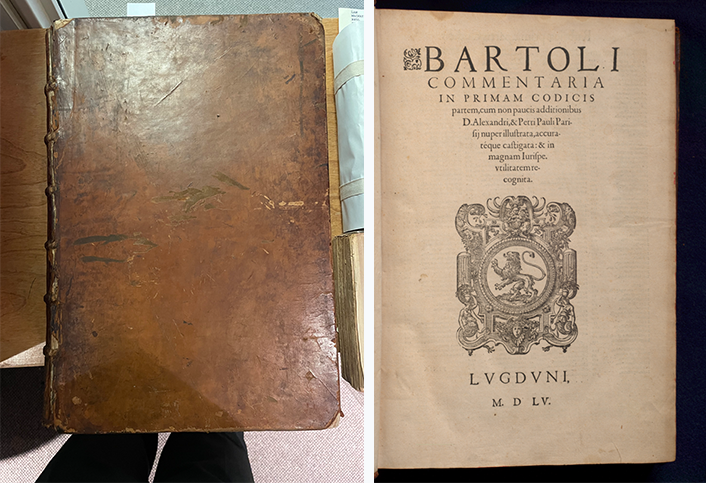
Take this 1537 folio, for example, titled In secundam Digesti verteris partem commentaria. Printed less than a century after Gutenberg’s printing press transformed book culture in Europe, this item is the second oldest book in the library’s holdings. It is a substantial work on Roman law and part of the Canadiana collection.
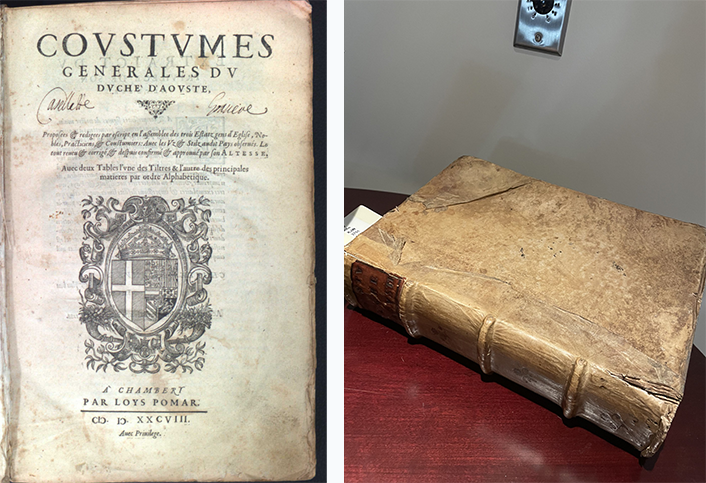
Another standout was Coustumes generales du duchè d’Aouste, a beautiful folio with a vellum cover from 1588. It is a rare legal text, with only four other recorded copies, and includes handwritten annotations from previous owners. This item is part of the Wainwright Collection.
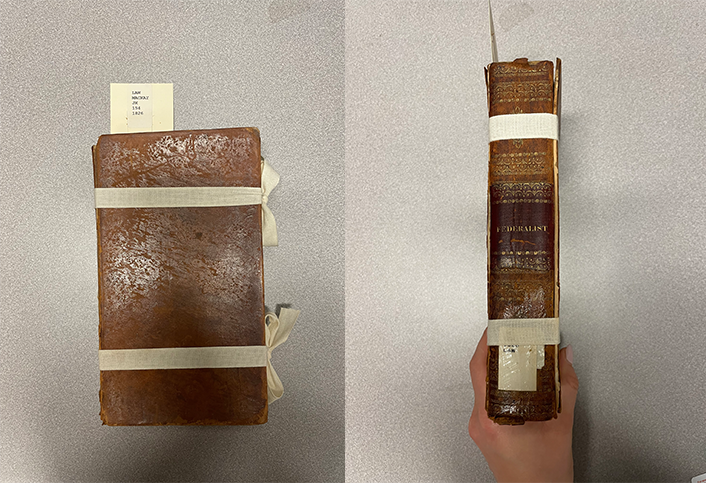
Finally, a personal highlight was the discovery of an 1826 copy of The Federalist Papers, written by Alexander Hamilton, James Madison, and John Jay. It contains all 85 essays written in 1787–1788 in support of the ratification of the United States Constitution, as well as the original Articles of Confederation and the Constitution with its amendments. This item is part of the Hon. Judge Mackay Collection.
While these works are historically significant for their legal content, their physical features are equally fascinating. Some contain elaborate typography and decorative woodcut elements, while others have signatures from previous owners, or centuries of wear that reveal how heavily they were once used. Others remain remarkably well preserved despite their age. In many ways, the condition of the books themselves tells a uniquely personal story of past readership and material history.
Another major part of my project involved digitization. As previously mentioned, digital copies of the library’s special collections were sparse at best, and items that were digitized were difficult to discover. My position as a part-time Digitization Assistant at McGill’s Digitization Lab came especially in-handy here, as I was able to use my technical skills to directly contribute to multiple digitization initiatives aimed at improving access to these materials.
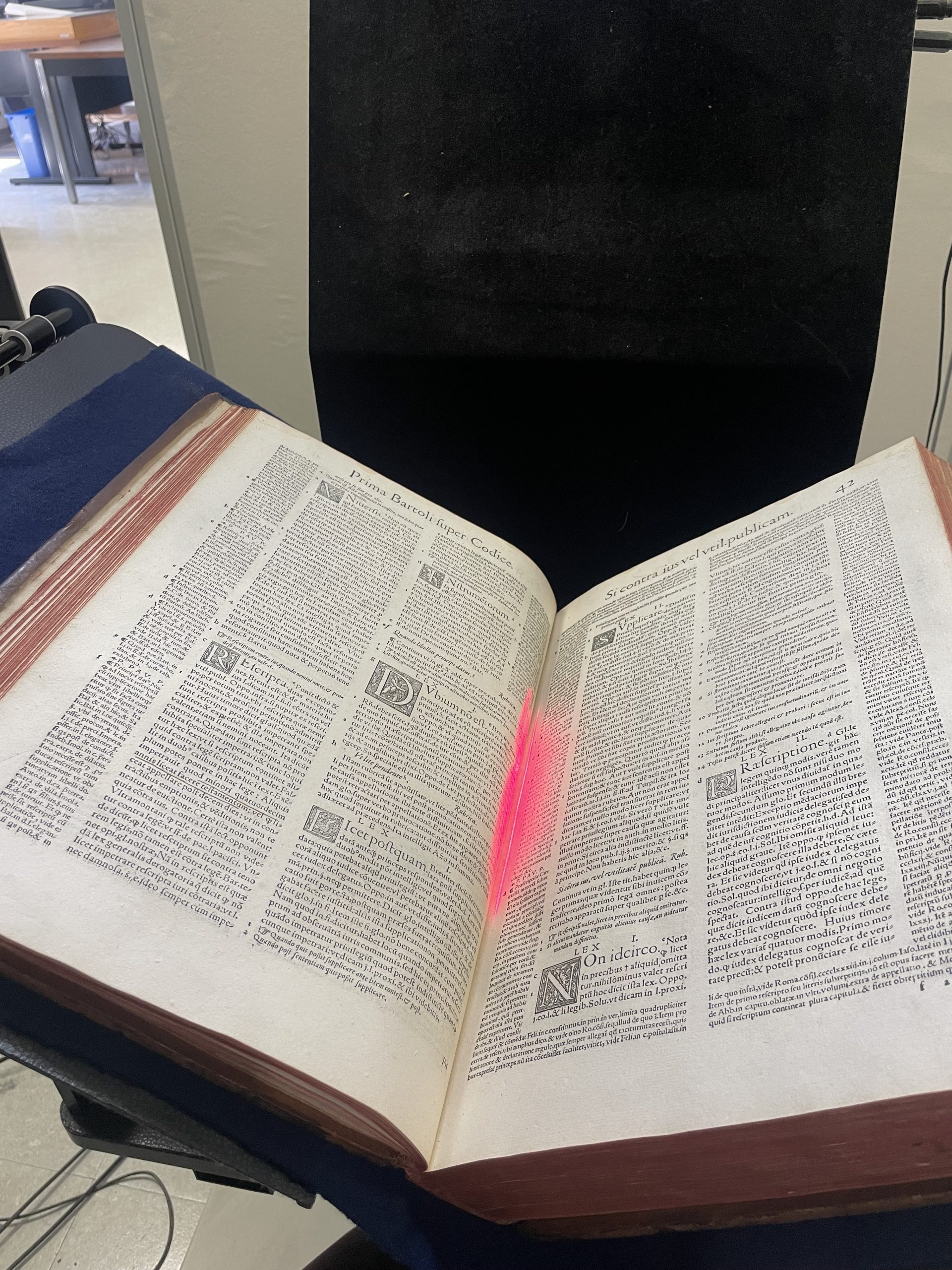
One short-term initiative involved personally digitizing selected works from across the Law Library’s collections in the Digitization Lab. Each item was carefully photographed beneath a cradle-mounted camera system to capture high-resolution images without stressing the bindings. Once digitized, the materials were then incorporated into the LibGuide as featured items and are now available for digital consultation on the Internet Archive.
This initiative expanded into larger conversations surrounding the long-term future of digitization within the Law Library’s collections, particularly the Wainwright Collection and the proposed François Olivier-Martin sub-collection project. It also revealed another side of special collections work that often remains invisible to users. Decisions about which items to prioritize, what is available in the public domain, and how materials contribute to research value all shape how researchers ultimately encounter special collections online. Much of this work involved creating spreadsheets, verifying copyright, and developing proposals – less romantic forms of labour, perhaps, but all essential parts of the puzzle to making historical materials accessible.
Today, the Law Library’s collections can be explored through the newly developed LibGuide for the Nahum Gelber Law Library’s Rare Books and Special Collections. The guide offers further information on the history and materials held in each collection, and I encourage anyone interested to explore it. Physical materials are also available for consultation upon request in the Peter M. Laing Special Collections Room, open Monday to Friday from 10 a.m. to 3:30 p.m.
I would like to extend my gratitude to all of McGill’s library staff for their support and interest throughout this project. A special thanks goes to Sandy Hervieux, Head Librarian at the Nahum Gelber Law Library, for her incredible mentorship, guidance, and kindness at every stage of my work. I would also like to thank Greg Houston, Head of Digitization, for his endless encouragement and for making the library’s digitization initiatives possible.
Exploration des collections de livres rares de la Bibliothèque de droit Nahum Gelber
Par Farane Zaidi, étudiante de 2e année à la maîtrise en sciences de l’information à McGill, ayant complété un stage en collections patrimoniales à la Bibliothèque de droit Nahum Gelber durant la session d’hiver 2026.
Il y a quelque chose d’étrangement surréaliste dans le fait de tenir entre ses mains, un après-midi de semaine tout ce qu’il y a de plus ordinaire, un livre imprimé il y a plus de cinq cents ans.
Du moins, c’est ce que je me disais chaque fois que j’ouvrais un livre qui, après des siècles de pérégrinations aux mains d’innombrables lecteurs, s’était retrouvé au deuxième étage de la Bibliothèque de droit Nahum‑Gelber. La salle Peter‑M.‑Laing abrite des collections comptant des milliers d’ouvrages rares, dont la Collection Wainwright, la Collection de l’honorable Robert Mackay, Canadiana et les Publications de la Faculté de droit, témoins discrets de plusieurs siècles d’histoire et de réflexion touchant le droit.
De janvier à avril 2026, soit pendant la dernière session de ma maîtrise en sciences de l’information, j’ai eu la chance inouïe de côtoyer ces trésors pendant un stage consacré aux collections spéciales. Mon projet : vérifier les fonds rares de la Bibliothèque de droit et en faciliter l’accès en créant une page Web LibGuide. J’ai eu tôt fait de comprendre que dans ce domaine, la véritable difficulté résidait non pas dans la conservation, mais bien dans la découvrabilité. En effet, ces ouvrages étant rarement numérisés, donc peu visibles en ligne et difficiles à trouver, ils dorment sur les rayons et la quasi-totalité de la communauté mcgilloise en ignore l’existence.
Pour remédier à la situation, je me suis d’abord demandé comment étaient présentées ces collections rares dans les Bibliothèques de l’Université McGill. La découverte des collections Livres rares et collections spéciales, de la Bibliothèque d’histoire de la médecine Osler et de la Bibliothèque de musique Marvin‑Duchow m’a permis de mieux comprendre comment organiser et répertorier les collections historiques, et comment les mettre en valeur auprès des utilisateurs de l’Université. Ce que je retiens essentiellement, c’est que les établissements ont tendance à privilégier les ressources d’exception, intéressantes sur le plan visuel ou précieuses pour l’enseignement et la recherche. Par ailleurs, il est très important de raconter l’histoire de ces trésors et de les mettre en contexte pour encourager leur exploration. J’ai retenu ces constats pour la création de ma page LibGuide et la présentation des collections de la Bibliothèque de droit.
Ces visites ayant piqué ma curiosité, j’ai par la suite passé des heures dans la salle Peter‑M.‑Laing à me renseigner sur l’histoire des ouvrages en faisant des recherches dans le Web et en parcourant les rayons pour les examiner de visu. Cette chasse au trésor a été, sans conteste, la partie la plus passionnante de mon projet.
Prenons par exemple cet in-folio datant de 1537, intitulé In secundam Digesti verteris partem commentaria. Imprimé moins d’un siècle après l’invention, par Gutenberg, de la presse à imprimer qui allait révolutionner l’univers du livre en Europe, cet ouvrage est le deuxième plus ancien de la collection de la Bibliothèque. Il s’agit d’un ouvrage de référence sur le droit romain qui fait partie de la collection Canadiana.
Autre ouvrage remarquable : Coustumes générales du duché d’Aouste, magnifique in-folio dans une reliure en vélin datant de 1588. Il s’agit d’un ouvrage juridique rare, dont on ne recense que quatre autres exemplaires et qui comporte des annotations manuscrites d’anciens lecteurs. Cet article fait partie de la Collection Wainwright.
Enfin, l’un des moments forts pour moi a été la découverte d’un exemplaire de 1826 de The Federalist Papers, dont les auteurs sont Alexander Hamilton, James Madison et John Jay. Il renferme l’intégralité des 85 essais rédigés en 1787-1788 en faveur de la ratification de la Constitution des États-Unis, ainsi que le texte original des Articles de la Confédération et de la Constitution avec ses amendements. Cet article fait partie de la Collection de l’honorable Robert Mackay.
Ces ouvrages sont fascinants tant par leur valeur historique sur le plan du droit que par leurs caractéristiques physiques. En effet, certains affichent des attributs typographiques raffinés et sont ornés de gravures sur bois, tandis que d’autres portent les signatures d’anciens propriétaires ou les traces d’une usure séculaire témoignant de l’usage intensif qu’on en faisait autrefois. D’autres sont remarquablement bien conservés malgré leur âge. À bien des égards, l’état d’un livre nous raconte une histoire éminemment personnelle sur ses lecteurs et sa facture.
Par ailleurs, la numérisation constituait un autre grand volet de mon projet. Comme je l’ai souligné précédemment, seuls quelques rares éléments des collections spéciales étaient numérisés, et ceux qui existaient en version numérique étaient difficiles à trouver. C’est ici que mon travail d’assistante en numérisation à temps partiel au Laboratoire de numérisation de l’Université a pris toute son utilité : j’ai pu mettre à profit mes compétences techniques pour participer à de nombreux projets de numérisation visant à améliorer l’accès à ces documents.
C’est ainsi que j’ai numérisé moi-même certains ouvrages des collections de la Bibliothèque de droit dans le Laboratoire de numérisation. Chaque ouvrage a été soigneusement photographié à l’aide d’une caméra montée sur un support permettant d’obtenir des images haute définition sans endommager la reliure. Une fois numérisés, ces documents ont été intégrés au LibGuide et sont désormais consultables en ligne sur Internet Archive.
Ce projet ponctuel a donné lieu à des discussions sur l’avenir à long terme de la numérisation des collections de la Bibliothèque de droit, notamment de la Collection Wainwright et de l’éventuelle sous-collection de l’œuvre de François Olivier‑Martin. Il a également mis en lumière une autre facette de la gestion des collections spécialisées, souvent invisible pour l’utilisateur. Quels articles doit-on numériser en priorité? Lesquels relèvent du domaine public? Quelle est l’utilité de cet article en recherche? Ce sont toutes là des décisions qui influent sur l’accessibilité en ligne des collections pour les chercheurs et chercheuses. Une grande partie de ce travail consiste à créer des tableaux, à vérifier les droits d’auteur et à élaborer des propositions : si prosaïques soient-elles, ces tâches sont pourtant essentielles à l’accessibilité des ouvrages historiques.
Aujourd’hui, on peut découvrir les collections de la Bibliothèque de droit grâce au tout nouveau LibGuide consacré aux Livres rares et collections spéciales de la Bibliothèque de droit Nahum‑Gelber. J’invite toutes les personnes intéressées à consulter ce guide : elles y trouveront de l’information sur l’histoire et le contenu de chaque collection. Il est également possible de consulter les documents physiques sur demande; la salle des collections spéciales Peter‑M.‑Laing, est ouverte du lundi au vendredi, de 10 h à 15 h 30.
En terminant, je tiens à remercier chaleureusement le personnel des Bibliothèques de McGill pour son aide et son intérêt pendant la réalisation de mon projet. Je remercie tout particulièrement Sandy Hervieux, bibliothécaire en chef de la Bibliothèque de droit Nahum‑Gelber, pour son mentorat, ses judicieux conseils et la gentillesse qu’elle m’a témoignée du début à la fin de mon travail. Ma reconnaissance va également à Greg Houston, chef de la numérisation, qui a toujours su m’encourager et sans lequel ces initiatives ne pourraient se concrétiser.


Leave a Reply
You must be logged in to post a comment.