



By Octavian Sopt, Senior Documentation Technician, Rare Books and Special Collections
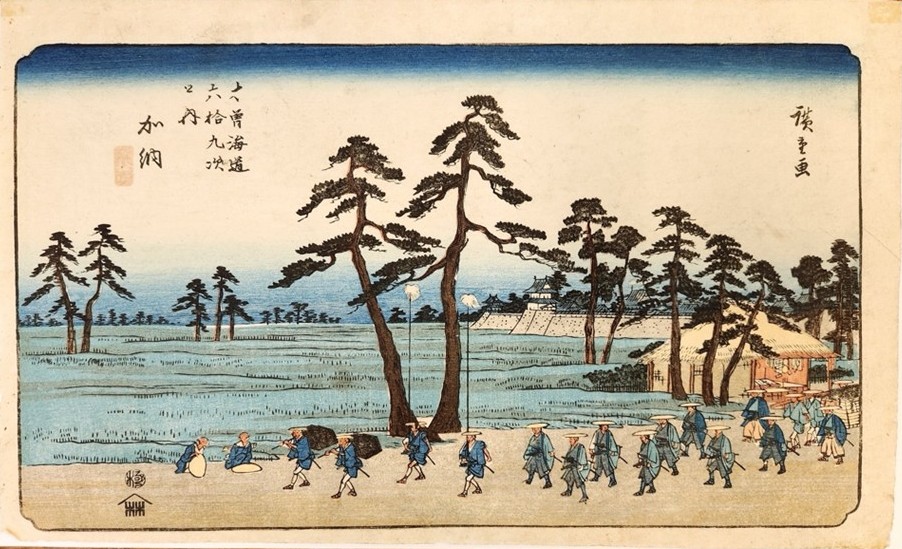
At the onset of gray winter weather, I think about the multitude of vibrant colors that filled the exhibition cases in the 4th floor lobby of the McLennan Library building from May to September 2025 as part of the Views of the Natural World in Chinese and Japanese Prints exhibiton. Lustrous red hues, warm shades of yellow, and especially magnetic jewel-like blue tones shone through the exhibition cases as part of a display of almost 50 prints housed in Rare Books and Special Collections. The display included several woodblock prints depicting elements of the natural world made by 19th century ukiyo-e artists, such as Katsushika Hokusai and Utagawa Hiroshige. Ukiyo-e (often translated as Pictures of the Floating World)is a genre of woodblock printing and painting born during Japan’s Edo Period (1603-1868). Ukiyo-e prints featuring several different colours are referred to as nishiki-e, and they often depict a wide array of scenes and figures, including landscapes, actors, courtesans, and daily life.
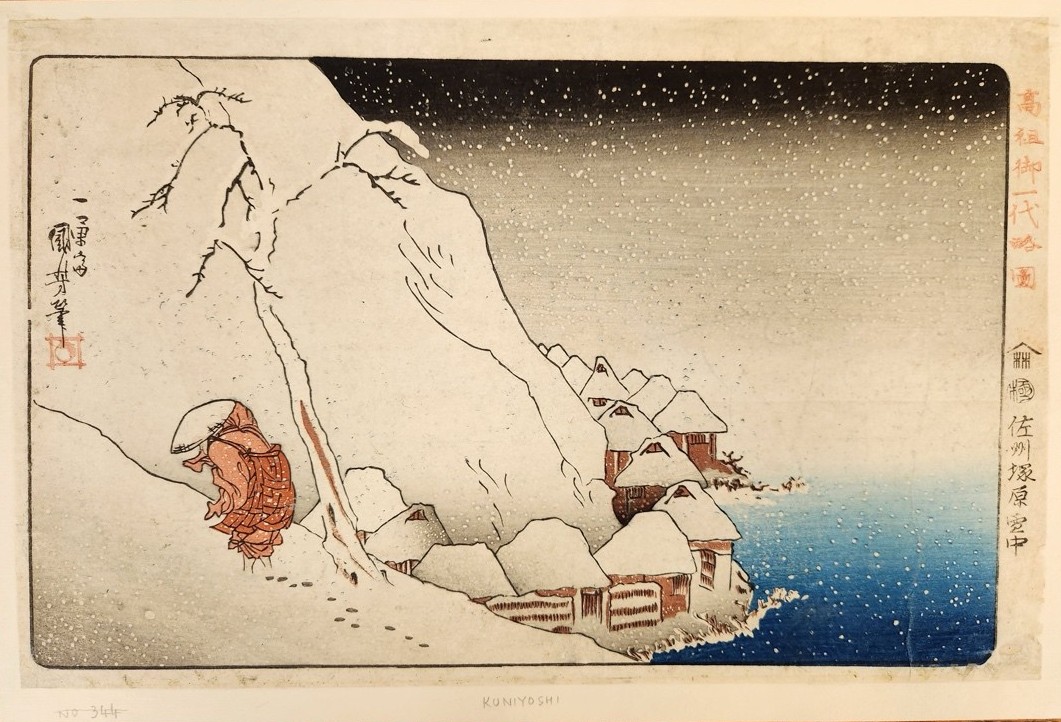
While selecting material to include in the display, prints featuring a brilliant blue colour stood out. In the early 19th century, a “blue revolution” began in ukiyo-e print production. Prints featuring an array of blue tones made with natural pigments such as indigo and dayflower as well as a newly introduced synthetic colorant known in Europe as “Prussian Blue” or “Berlin Blue” (bero-ai) in Japan became increasingly prevalent.[i] Prussian blue is a synthetic pigment originally created by Johann Conrad Dippel and Johann Jacob von Diesbach around the first decade of the 18th century.[ii] The synthetic pigment was well-suited to printing and it has greater resistance to fading compared to colourants of vegetal origins. Katsushika Hokusai’s famed Thirty-Six Views of Mount Fuji (1830) is a notable example of the use of both natural and Prussian hues of blue in ukiyo-e prints.[iii]
Some recent studies have analyzed ukiyo-e prints to explore the potential applications of new technologies for the study of natural and synthetic pigments, presenting exciting new possibilities for understanding the coexistence of colourants in these artworks.[iv] While it is difficult to determine the exact nature of the pigments used in the prints housed in Rare Books and Special Collections, the vivid blue tones that illuminated the 4th floor lobby throughout the summer are a testament to their enduring ability to bring nuance and depth to depictions of daily life and the natural world.
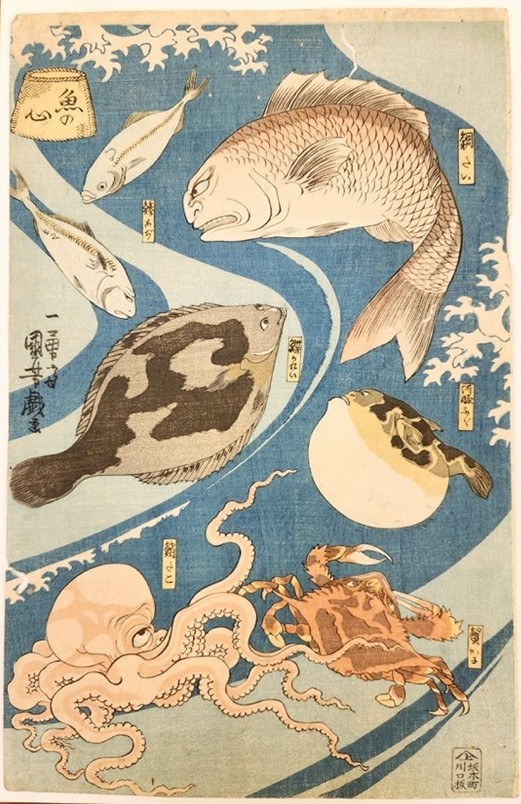
In addition to the prominent use of striking blue tones, Uo no Kokoro by Utagawa Kuniyoshi (pictured above) features a dynamic scene of sea creatures in motion through underwater currents. The sea creatures have lively expressions, intended to evoke the faces of recognizable Kabuki actors of the day.[v] The Tenpō Reforms of the Tokugawa Shogunate imposed between 1841 and 1843 forbade the depiction of actors in art. Many artists found creative ways to circumvent these restrictions by creating images of famous actors who could be easily recognized by their facial expressions without being named.[vi]
Although no longer on display in McLennan Library, Edo period prints featuring the vibrant blue tones shown above as well as other works by renowned ukiyo-e artists and printmakers such as Katsushika Hokusai are available for consultation upon request in the Rare Books and Special Collections reading room, open Monday to Thursday from 10 a.m. to 6 p.m.
References
Biron, Carole, Aurélie Mounier, Gwénaëlle Le Bourdon, Laurent Servant, Rémy Chapoulie, and Floréal Daniel. “A Blue Can Conceal Another! Noninvasive Multispectroscopic Analyses of Mixtures of Indigo and Prussian Blue.” Color Research & Application 45, no. 2 (2020): 262–74. https://doi.org/10.1002/col.22467.
Cesarotto, Anna, Yan-Bing Luo, Henry D. Smith II, and Marco Leona. “A Timeline for the Introduction of Synthetic Dyestuffs in Japan during the Late Edo and Meiji Periods.” Heritage Science 6, no. 1 (2018): 1–12. https://doi.org/10.1186/s40494-018-0187-0
Davis, Julie Nelson, Picturing the Floating World: Ukiyo-E in Context. Honolulu: University of Hawaiʻi Press, 2021. https://doi.org/10.1515/9780824889333.
Fine Arts Museum of San Francisco. “Kabuki Actors as Fish (Uo No Kokoro),” accessed November 5, 2025, https://www.famsf.org/artworks/kabuki-actors-as-fish-uo-no-kokoro
Smith, Henry D. II. “Hokusai and the Blue Revolution in Edo Prints.” In Hokusai and His Age: Ukiyo-E Painting, Printmaking and Book Illustration in Late Edo Japan, edited by John T. Carpenter. Amsterdam: Hotei, 2005. https://doi.org/10.7916/d8-hxn2-xg8.
Vermeulen, Diego Tamburini, Emily M K Müller, Silvia A Centeno, Elena Basso, and Marco Leona. “Integrating Liquid Chromatography Mass Spectrometry into an Analytical Protocol for the Identification of Organic Colorants in Japanese Woodblock Prints.” Scientific Reports 10, no. 1 (2020): 20921. https://doi.org/10.1038/s41598-020-77959-2.
Wentrup, Curt. “The Gold-Maker of Animal Oil and Prussian Blue Fame – the Chemical and Medicinal Science Philosophy of Johann Conrad Dippel”, Chemical Record (New York, N.Y.) 25, no. 7 (2025): p.10, e202500043. https://doi.org/10.1002/tcr.202500043.
Footnotes
[i] Henry D. Smith II, “Hokusai and the Blue Revolution in Edo Prints”, in Hokusai and His Age: Ukiyo-E Painting, Printmaking and Book Illustration in Late Edo Japan, edited by John T. Carpenter. Amsterdam: Hotei, 2005, pp. 235-239; Julie Nelson Davis, Picturing the Floating World: Ukiyo-E in Context. Honolulu: University of Hawaiʻi Press, 2021, 122. https://doi.org/10.1515/9780824889333.
[ii] Curt Wentrup, “The Gold-Maker of Animal Oil and Prussian Blue Fame – the Chemical and Medicinal Science Philosophy of Johann Conrad Dippel”, Chemical Record (New York, N.Y.) 25, no. 7 (2025): p.10, e202500043. https://doi.org/10.1002/tcr.202500043.
[iii] Davis, Picturing the Floating World: Ukiyo-E in Context, 122; Smith, “Hokusai and the Blue Revolution in Edo Prints”, p. 122.
[iv] See for example: Carole Biron, Aurélie Mounier, Gwénaëlle Le Bourdon, Laurent Servant, Rémy Chapoulie, and Floréal Daniel. “A Blue Can Conceal Another! Noninvasive Multispectroscopic Analyses of Mixtures of Indigo and Prussian Blue.” Color Research & Application 45, no. 2 (2020): 262–74. https://doi.org/10.1002/col.22467; Anna Cesarotto, Yan-Bing Luo, Henry D. Smith II, and Marco Leona. “A Timeline for the Introduction of Synthetic Dyestuffs in Japan during the Late Edo and Meiji Periods.” Heritage Science 6, no. 1 (2018): 1–12. https://doi.org/10.1186/s40494-018-0187-0.; Marc Vermeulen, Diego Tamburini, Emily M K Müller, Silvia A Centeno, Elena Basso, and Marco Leona. “Integrating Liquid Chromatography Mass Spectrometry into an Analytical Protocol for the Identification of Organic Colorants in Japanese Woodblock Prints.” Scientific Reports 10, no. 1 (2020): 20921. https://doi.org/10.1038/s41598-020-77959-2.
[v] “Kabuki Actors as Fish (Uo No Kokoro),” Fine Arts Museum of San Francisco, accessed November 5, 2025, https://www.famsf.org/artworks/kabuki-actors-as-fish-uo-no-kokoro. The Fine Arts Museum of San Francisco also holds a copy of the same print.
[vi] Davis, Picturing the Floating World: Ukiyo-E in Context, 140.


Leave a Reply
You must be logged in to post a comment.