


By Aurora Rose (Nêhiyawak/Plains Cree First Nations, McGill Visual Arts Collection Intern, 2025-)
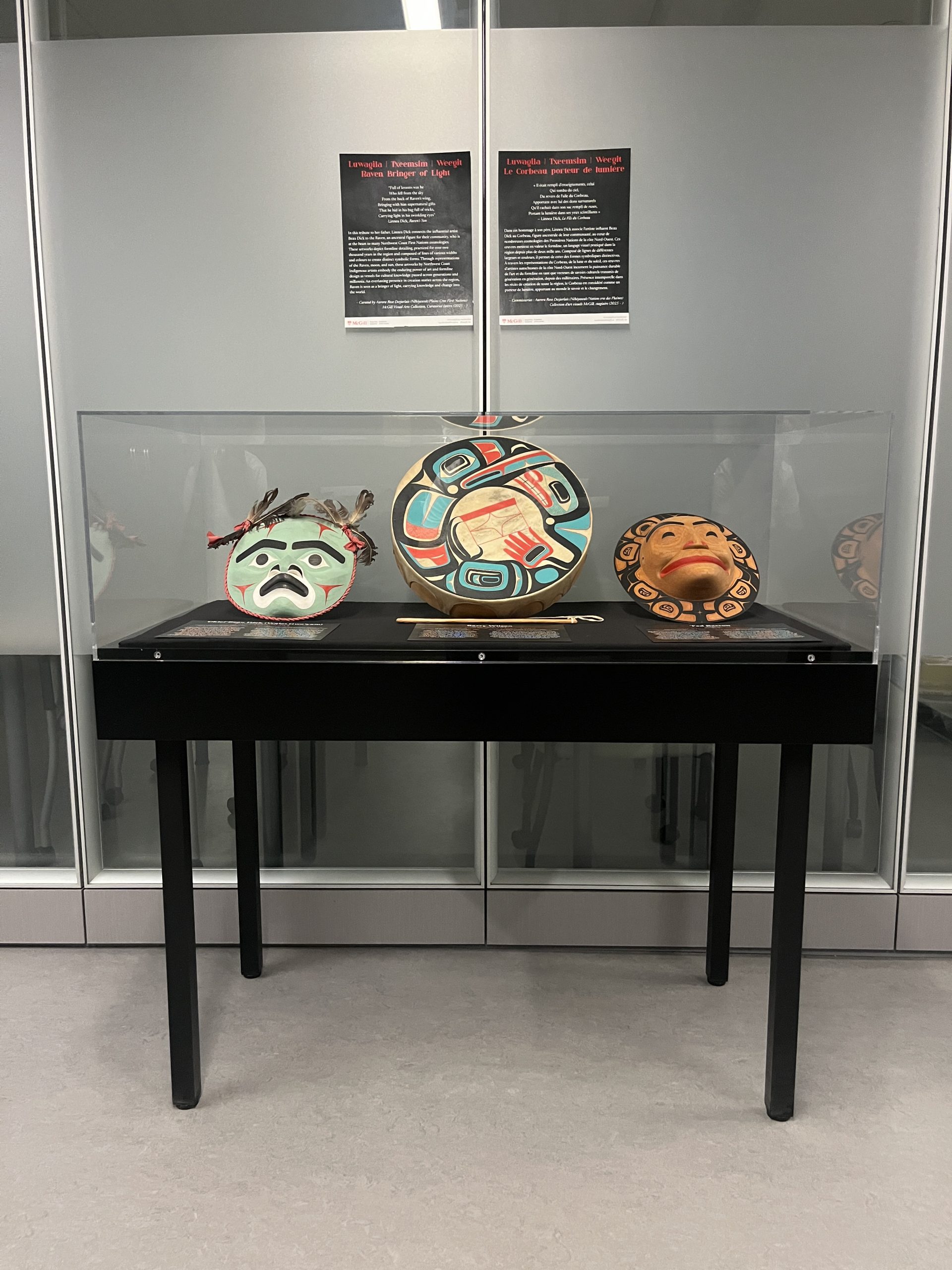
Among Northwest Coast Nations, the Raven is the bringer of light. The Moon Mask, Raven Stealing Light Drum, andthe Sun Mask in the McGill Visual Arts Collection and display case in the Desautels Faculty of Management, were created from artists from the Kwakwaka’wakw, X̄á’isla, and Nisga’a communities respectively, each with their own understanding of the Raven (Fig. 1). For members of the Musgamakw Dzawada’enuxw First Nation, the Raven, known as Luwagila, is their ancestor.[1] For the X̄á’isla, the Raven is called Wee’git, and he brought forth the moon.[2] For the Nisga’a, the Raven is called Txeemsim, and he created the sun. Each iteration of the Raven is a trickster and transforms at will, and this legacy can be seen in this display. These artworks embody over ten thousand years of creativity, the practice of cultural traditions, and relationships between the people and the land and seas on which they inhabit. They all reveal the artistic technique of formline, which has been used for more than two thousand years, and is composed of lines of various widths to create symbolic form.[3] Each artwork embodies land-based knowledge from one of the richest environments in the world. [4] Together they demonstrate the inherent ability of art and material culture to empower the Kwakwaka’wakw, X̄á’isla, and Nisga’a Peoples.
I am part of the Nêhiyawak First Nations community from the West in Alberta/Saskatchewan.[5] I am now living in Tiohtià:ke as a guest on the traditional lands of the Kanien’kehá:ka people, who are the caretakers of these lands.[6] I remember learning about the many stories from Indigenous communities across Turtle Island as I grew up, often interlaced with my language Nêhiyawêwin. I always found the stories to be exciting, and they sparked a curiosity for knowledge within me. I want to emphasize that I am not a member of any First Nation represented in this display case, an Elder or Knowledge Keeper for these stories, so I recommend seeking out stories from them if you are interested. Through the exhibition of these beautiful works of art, I see an opportunity to introduce others to Indigenous teachings about Kâhkâkiw.[7]
II: Beau Dick’s Moon Mask
For the Kwakwaka’wakw, the Raven was the one who brought light to the darkness.[8] In this story, the Raven learned that a fisherman and his daughter had the moon in a box. The Raven wanted that light, so he searched for an opportunity by observing the daughter. When she walked by one day, Raven fell into her body as a leaf, causing her to become pregnant. She gave birth to a baby that looked like a Raven. The child was drawn to the box and cried for it. His mother opened the box and gave him the ball of light to soothe him. He continued to cry for the stars outside. After she opened the smoke hole, he transformed into a raven and flew away, carrying the moon in his beak. He threw the moon into the night sky, where it continues to illuminate the night to this day.
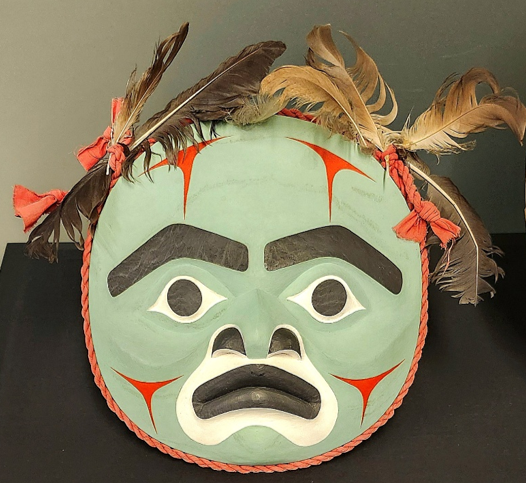
The red cedar Moon Mask (Fig. 2)depicts the moon with humanoid features encompassed by formline detailing in three traditional colours.[9] Crimson red trigons are featured, accenting the red corona made of rope. Here, the formline techniques help bring the moon alive with expression.
III: Barry Wilson’s Raven Stealing Light Drum
In X̄á’isla cosmology, Wee’git is a trickster full of mischief with attributes of a god, shapeshifting into any form at will.[10] In the beginning, the Sun was shining during the day, and the night was full of darkness. Wee’git wanted to change that, and he thought of the Nagwachi, a “luminous globe” belonging to an old man and his daughter. Transforming into a raven, he observed the daughter as she visited a well with her pail. Seizing the opportunity, Wee’git transformed into a pine needle and dropped himself into the pail. She drank the water and miraculously became pregnant, soon giving birth to Wee’git in the form of a baby. One day, while his grandfather slept, Wee’git took the Nagwachi. Rolling it out the door, Wee’git woke his grandfather, who chased him. Wee’git threw the Nagwachi up into the sky, transformed into a raven, and flew away. The Nagwachi stayed in the night sky, forever providing the mischievous Wee’git the light in the night he so desperately wanted.
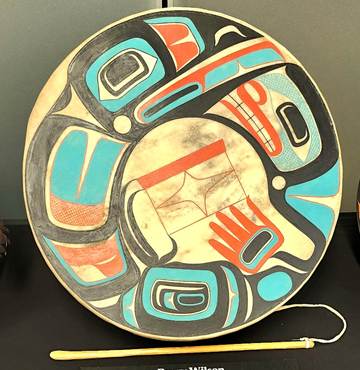
The Raven Stealing Light Drum (Fig. 3) features a formline depiction of Wee’git in the moment of stealing the Nagwachi, in three traditional colours. The outlines of the raven and man are formed by the signature thick black lines. The crimson red hand and box at the centre are known as secondary space in formline. The tertiary space is encompassed by either the primary or secondary space and is traditionally blue/green, as seen in the artwork.
IV: Ted Barton’s Sun Mask
Ted Barton, the artist of the Sun Mask (Fig. 4), is from Nisga’a First Nation, who are of the K’alii-Aksim-Lisims (Nass River) that flows through sacred mountains and forests on the Pacific Coast of Turtle Island.[11] [12]
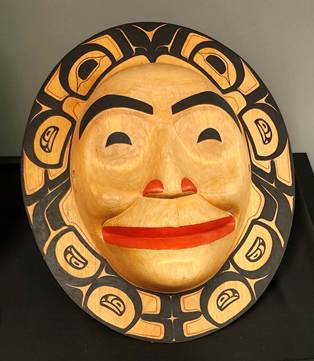
In the creation stories of the Nisga’a, Txeemsim was sent by K’amligiihahlhaahl, the Chief of Heavens, to help the People.[13] The Nisga’a People lived near the river in darkness, and Txeemsim was the one who changed that.[14] [15] Through these stories, it is seen that Txeemsim is an approachable supernatural being, a demi-god that can transform at will, full of human failings and a sense of humour—though he is also a greedy thief, trickster, and liar. [16] [17] Fortunately for humans, his insatiable curiosity can also bestow gifts upon humanity, such as the Sun.[18] Barton’s Sun Mask honours this story, embodying the positive traits of this timeless Trickster.
V: Conclusion
Through metamorphosis, the Raven in all forms (Luwagila, Wee’git, and Txeemsim) transformed to bring forth light, which still exists and connects us all. This knowledge has been passed down through the power of storytelling during ceremony, uniting communities. I am honoured to contribute to this living tradition. Though I may not be of the represented communities, I am of the Nêhiyawak First Nation and learning and sharing these beautiful stories is something that brings me to life. I hope that you have been impacted, inspired, and encouraged after reading about Kâhkâkiw. Ninanâskomon.
[1] Luwagila is the Kwak´wala word, language of the Kwakwaka’wakw people, for Raven.
[2] Wee’git is the word for Raven for the X̣àʼisla people. There are also numerous variations of Wee’git, but I will focus on one variation in this post.
[3] A collection of these formline shapes composes an image or design, and they may represent stories of the Raven (the Trickster), historical events, clan crests, or other concepts. See Worl, Rico, Shaadooʹtlaa, Donald Gregory, and Sealaska Heritage Institute, A Basic Guide to Northwest Coast Formline Art (Sealaska Heritage Institute, 2014), 1, 3-7, 31.
[4] Haa’yuups, et al. Empowering Art: Indigenous Creativity and Activism from North America’s Northwest Coast (Sainsbury Centre for Visual Arts, 2023), 9.
[5] The English translation for the word Nêhiyawak is Cree.
[6] The English word for Tiohtià:ke is Montreal.
[7] Kâhkâkiw is the word for Raven in Nêhiyawêwin
[8] The following story is paraphrased from the source: Jaguar Bird, “The Raven and the Moon: A Kwakiutl Myth,” Video, Posted May 18th, 2021, YouTube, 8:43, https://www.youtube.com/watch?v=ngkLngKQgNE.
[9] The material that the mask is most likely made from is red cedar. See The Living World: Plants and Animals of the Kwakwaka’wakw (U’mista Cultural Society, 1998) for more details.
[10] This story is paraphrased from the source: Gordon Robinson, Tales of Kitamaat: A Selection of Legends, Folk Stories and Customs of the Haisla People, a Branch of the Kwakiutl Indian Language-Group Who Live on the West Coast of British Columbia (Northern Sentinel Press, 1961), 1-2.
[11] Nishga Tribal Council. Nisg̲a’a: People of the Nass River (Douglas & McIntyre, 1993). 1.
[12] FirstVoices, “K’amligiihahlhaahl,” effective June 2026, https://www.firstvoices.com/nisgaa/words/cef620b5-0b9b-4498-a87f-c7c4f4c68701.
[13] Nisga’a Language & Culture, “Our History,” effective July 2026, https://nisgaalanguage.ca/who-we-are/our-history/.
[14] Nisga’a Lisims Government, “Historym” effective April 2026, https://www.nisgaanation.ca/government/history/.
[15] Allyson Kis writes in “Finding the headwaters” that in the Nisga’a system of beliefs, “the creation story” begins as K’am Ligii Hahlhaahl (Chief of Heavens) sent people down to earth along Lisims and regrouped them into four clans: the Laxsgiik (Eagle), the Laxgibuu (Wolf), the Ganada (Raven) and the Giskaast (Killerwhale) along with the Owl. See Allyson Kis, “Finding the Headwaters.” Perspectives on Global Health, October 11, 2022, https://www.perspectivesmcgill.com/allposts/2022/10/11/finding-the-headwaters
[16] Txeemsim is pronounced “X-lemm-soom.” Listen to audio from the following reference: “luuw̓atkw,” First Voices, effective June 2026, https://www.firstvoices.com/nisgaa/words/038f2809-a2bc-4d50-bdc6-70bf8a76332e.
[17] Amy Parent, “Txeemsim Bends the Box to Bring New Light to Working with Indigenous Methodologies,” in Critical Theorizations of Education, edited by Abdi, Ali A. (Brill Press, 2021), 3.
[18] Ibid. 3-4.
Selected Bibliography
Bird, Jaguar. “The Raven and the Moon: A Kwakiutl Myth.” Video, Posted May 18th, 2021, by Jaguar Bird, YouTube, 8:43, https://www.youtube.com/watch?v=ngkLngKQgNE
Dick, Beau, Justin Barski, Linnea Dick, Darrin J. Martens, Peter Morin, and Audain Art Museum. Beau Dick: Revolutionary Spirit. Vancouver, Whistler, BC, Canada: Figure.1; Audain Art Museum, 2018.
First Voices, “luuw̓atkw.” Effective June 2026. https://www.firstvoices.com/nisgaa/words/038f2809-a2bc-4d50-bdc6-70bf8a76332e
First Voices, “K’amligiihahlhaahl.” Effective June 2026. https://www.firstvoices.com/nisgaa/words/cef620b5-0b9b-4498-a87f-c7c4f4c68701
Haisla Nation, “Haisla History.” Effective March 2026. https://haisla.ca/haisla-history/
Haa’yuups, Ishmael Khaagwáask’ Hope, Kaitlin McCormick, and Jordan Wilson. Empowering Art: Indigenous Creativity and Activism from North America’s Northwest Coast. Edited by Jack Davy. Norwich: Sainsbury Centre for Visual Arts, 2023.
Kis, Allyson, “Finding the Headwaters.” Perspectives on Global Health, October 11, 2022. https://www.perspectivesmcgill.com/allposts/2022/10/11/finding-the-headwaters
Nisga’a Language & Culture, “Our History.” Effective July 2026. https://nisgaalanguage.ca/who-we-are/our-history/
Nisga’a Lisims Government, “History.” Effective April 2026. https://www.nisgaanation.ca/government/history/
Nishga Tribal Council. Nisg̲a’a: People of the Nass River. Vancouver: Douglas & McIntyre, 1993.
Pasco, Juanita, Brian Douglas Compton, Lorraine Hunt, and U’mista Cultural Society. The Living World: Plants and Animals of the Kwakwaka’wakw. Alert Bay, B.C.: U’mista Cultural Society, 1998.
Parent, Amy. “Txeemsim Bends the Box to Bring New Light to Working with Indigenous Methodologies.” In Critical Theorizations of Education, edited by Abdi, Ali A. Leiden: Brill Press, 2021.
Robinson, Gordon. Tales of Kitamaat: A Selection of Legends, Folk Stories and Customs of the Haisla People, a Branch of the Kwakiutl Indian Language-Group Who Live on the West Coast of British Columbia. 3rd ed. Kitimat, B.C.: Northern Sentinel Press, 1961.
Shearar, Cheryl. Understanding Northwest Coast Art: A Guide to Crests, Beings, and Symbols. Vancouver, B.C, Seattle: Douglas & McIntyre; University of Washington Press, 2000.
Worl, Rico, Shaadooʹtlaa, Donald Gregory, and Sealaska Heritage Institute. A Basic Guide to Northwest Coast Formline Art. Juneau, Alaska: Sealaska Heritage Institute, 2014.
X̄á’islak̓ala, Wísenis, “Xaisla is a 3 syllable word.” YouTube Short. 34 seconds. Posted on August 10th, 2018, by @haislakala. https://www.youtube.com/shorts/v8e4wez01NA.
Acknowledgements
Ay ay | Ninanâskomon | Niawen’kó:wa | Thank you to:
Moira A. Hudgin
Michelle Macleod
Gwendolyn Owens
Jessica Regimbald
Holly Vestad
Wahéhshon Shiann Whitebean
For all your help in the creation of this display case!


Leave a Reply
You must be logged in to post a comment.