



This festive scene is taken from Rover’s Dinner Party, was a part of the Aunt Louisa’s Toy Books series, published by Frederick Warne & Co. in the mid-to-late 19th century. This popular line of illustrated children’s books blended entertainment with moral and educational themes. Like Rover’s fine canine dining story, these toy-books were illustrated with large, original, coloured plates printed by Kronheim and Co. with the finest quality chromolithographic techniques of the day. The printers for these toy books were very often the stars while the illustrators, regardless of their fame, often went uncredited.
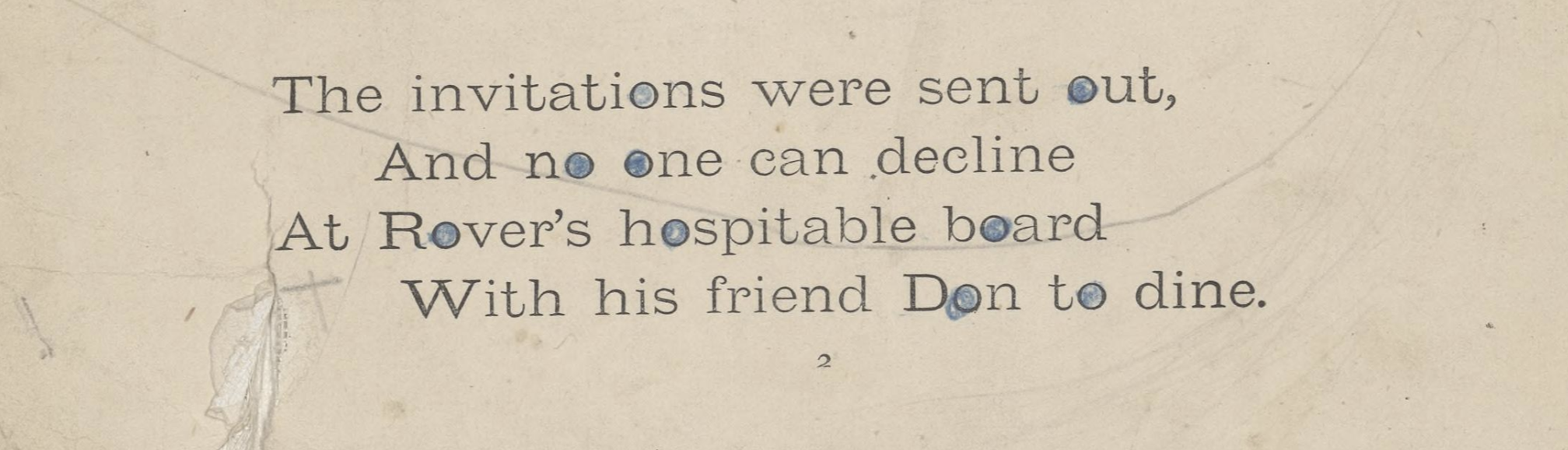
The McGill copy of this book has been very well loved by many wee readers over the years. Little hands have pencilled in many ds and os and scribbled in the margins. Many fingers have turned the pages–so many that this copy has lost pages and covers! While our copy is incomplete, intact copies exist at the library of Scotland and Cambridge University. They very kindly made copies and remote viewing available so that we could compare our dog-eared (pun intended) copy with an intact story. So, while we can appreciate the fine festive spirits of these doggy diners, we are missing some of the text, the cover – which identifies H.W. Petherick as the illustrator, as well as the central two-page spread that shows the entire dinner party at table. That toothsome spread shows well-clad canines about to drink a toast as a “footmen grand in plush” pace by with a dessert course. Fruit, fans, fine silks and frills clothe these society dogs as they each hold a glass of a light red wine – possibly sherry or madeira– to accompany the fruit course. I include a transcription of the full story below.
While our copy has not withstood the test of time and many readers, this edition was (believe it or not!) designed for durability. Every page is mounted on linen, making the pages near untearable. This worked: all the pages of our copy are intact and untorn, it was the binding and the covers that came undone at some point, resulting in lost signatures and covers. While backing the pages on linen was a common practice and a wise move for editions made for eager young readers, it was also more costly. Linen-backed toy-books cost two shillings rather than the standard one shilling for a paper copy of the same book.
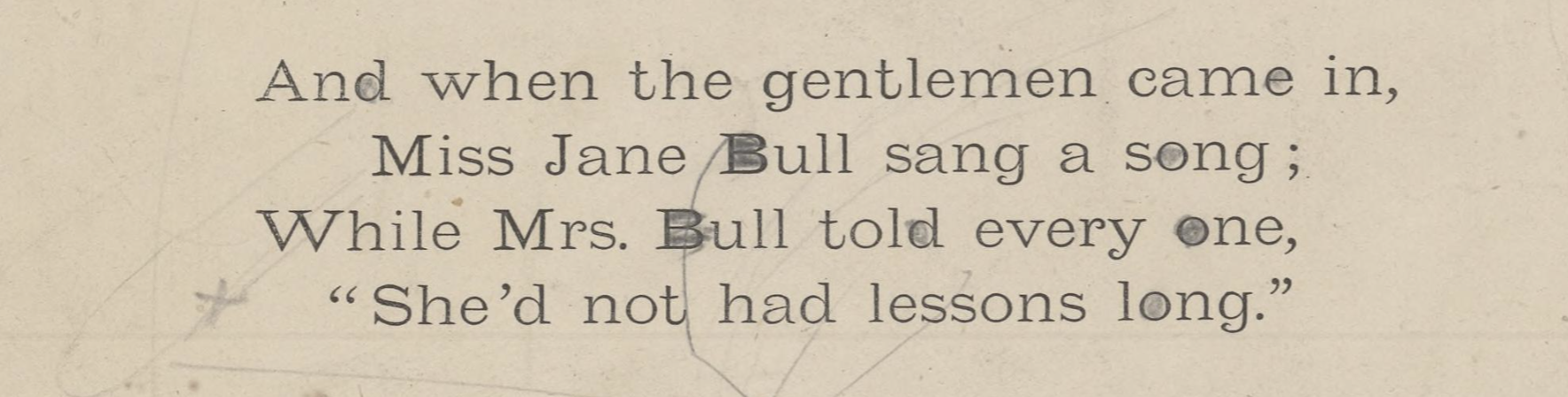
In Rover’s Dinner Party, young readers saw the dogs modelling society behaviour. Mrs. Bull plays hostess and leads the women to chat over “weather and the children.” Readers might aspire to be like Young Miss Jane Bull, who plays a song on the piano as her mother humble brags that “she has not had lessons long.” All in all, it is a lighthearted performance of festive Victorian hospitality.
ROVER’S DINNER PARTY
OLD ROVER was a country dog,
He led a single life;
He always said he’d rather not
Be troubled with a wife.
One day beneath the orchard trees
With his friend Don he sat;
And about “meets” and sporting news
They had a pleasant chat.
At last Squire Rover said, “I mean,
While you ‘re a guest of mine
To ask the neighbours to the Hall,
With you, friend Don, to dine.”
Don wagged his tail, and thanked his friend
–With very great delight ·
“And may I ask,” he, smiling, said,
“What guests you will invite?”
“Well, let me see: there’s Mr. Bull,
And Mrs. Bull, his wife;
Jane Bull, and Mr. Newfoundland,
Who saved young master’s life.
“For ladies-young and pretty too
There are Italian pets,
Toy terriers, and Cuba belles,
Who live in first-rate sets.
“And as for sporting characters,
I really needn’t say
How many members of the hunt
Have kennels down this way.”
Said Don, “A very pleasant set !
It will be quite a treat
So many worthy dogs, dear friend,
At your kind feast to meet.”
The invitations were sent out,
And no one can decline
At Rover’s hospitable board
With his friend Don to dine.
A cordial welcome they are sure
At Rover’s house to find·
And dogs, like children, love ‘ to go
Where friends are always kind.
And now the happy day is come,
The guests are ushered in
And Rover, very grandly drest,
His friends is welcoming.
First to arrive is Mr. Bull
He seldom is too late,
Though for his wife, and daughter too,
Sometimes compelled to wait.
Next comes Miss Fanny, dressed in silk,
A gold chain round her neck,
Her black eyes shining like two stars;
With flowers her head is decked.
And by her side a noble dog,
Bearing a glorious name;
From snowy mountains far away,
General St. Bernard came.
The guests have all at last arrived;
Then loudly sounds the gong,
And to the dining-room, in pairs,
They slowly moved along,
And soon were seated at the feast
Dinner à la Russe-
The soup and fish were handed round
By footmen grand in plush.
While all the time they ate and talked,
Dessert attention claimed ;
And very pretty looked the fruit
In autumn flowers framed.
“I hope,” said worthy Mr. Bull,
” You’ll not forget, dear host,
To keep our good old custom up,
And let us drink a toast.”
Dog Rover nodded an assent,
And rising, said, “I give
The health of our most gracious Queen,
Long may Victoria live!”
They drank the toast with loyal glee;
And then again began
The laughter low and murmured chat,
Till, shutting up her fan,
Good Mrs. Bull–who by request
Had filled the hostess’ place–
signal gave; the ladies rose
And left the room with grace.
While Rover’s friends enjoyed their wine,
The ladies sat together,
And in the drawing-room discussed
Their children and the weather.
And when the gentlemen came in,
Miss Jane Bull sang a song;
While Mrs. Bull told every one,
“She’d not had lessons long.”
Good Mr. Bull, and Dean Greyhound,
And Farmer Dinmont Brown,
And Captain Foxfind, to a game
Of whist had settled down.
And thus the pleasant evening sped
(Too rapid in its flight),
Until the ladies (with warm thanks)
To Rover bade “Good night.”
Then, gathered in the smoking-room
To talk all matters over,
The sporting dogs remained awhile
“With “that good fellow” Rover.
How long they sat, and all they said
I shall not stop to say ;
But I have heard they left the house
Just at the break of day.
Remix des Fêtes | Rover’s Dinner Party
Cette scène festive est tirée de Rover’s Dinner Party, ouvrage de la série Aunt Louisa’s Toy Books, publiée par Frederick Warne & Co entre le milieu et la fin du xixe siècle. Très populaire à l’époque, cette collection destinée aux enfants abordait de manière ludique des thèmes moraux et éducatifs. Ces « livres-jouets » se distinguaient par leurs grandes planches en couleurs, réalisées selon les techniques chromolithographiques les plus raffinées du temps et imprimées par Kronheim & Co. Quelle que fût leur renommée, les illustrateurs de ces livres demeuraient le plus souvent anonymes : les véritables vedettes étaient les imprimeurs.
L’exemplaire conservé à l’Université McGill est manifestement passé entre les mains de nombreux petits lecteurs au fil des ans, comme en témoignent les gribouillages qui en garnissent les pages. En fait, il a été lu si souvent que plusieurs des pages et la couverture ont disparu! Heureusement, on peut cependant trouver des exemplaires intacts à la Bibliothèque d’Écosse et à l’Université de Cambridge, qui ont eu la gentillesse de nous offrir un accès à distance pour comparer notre exemplaire aux leurs. Car, si la bonne humeur festive des convives canins continue de faire sourire, notre copie est néanmoins amputée de plusieurs pages, de la couverture et, surtout, de l’illustration centrale : une double page sur laquelle apparaît l’ensemble de la tablée de chiens élégamment vêtus, prêts à porter un toast, tandis que des valets s’avancent avec le dessert. Fruits décoratifs, éventails, soie fine et collerettes mettent en valeur ces chiens de la haute société, chacun tenant un verre de vin rouge – ou encore de xérès ou de madère. Je joins au-dessus une transcription de l’histoire complète.
Notre exemplaire a certes souffert de l’épreuve du temps et survécu à d’innombrables lectures, mais, aussi surprenant que cela puisse paraître, l’édition avait été conçue pour durer. En effet, le papier utilisé est entoilé, ce qui le rend pratiquement indéchirable. La preuve : toutes les pages sont intactes et seule la reliure s’est détachée, entraînant la perte des couvertures et des signatures. Cette technique judicieuse, courante pour les livres destinés aux jeunes lecteurs, était toutefois coûteuse : un exemplaire ainsi fabriqué valait deux shillings, contre un shilling pour l’édition ordinaire.
Dans Rover’s Dinner Party, les chiens reproduisent les comportements de la société. Mme Bull, jouant les hôtesses, entraîne les femmes à parler météo et enfants. Et pendant que la jeune Mlle Jane Bull, à laquelle les jeunes lecteurs pouvaient s’identifier, interprète un morceau au piano, maman souligne avec une feinte modestie que sa fille « n’a pas pris de leçons depuis longtemps ». L’ensemble compose une scène légère, reflet de l’hospitalité festive propre à l’époque victorienne.


Leave a Reply
You must be logged in to post a comment.