



By Aurora Rose Desjarlais (Nêhiyawak/Plains Cree First Nations, McGill Visual Arts Collection Intern, 2025-)
A sculpture that has always caught my eye on McGill’s campus is Exaltation by Giovanni Porretta. It is located in the James Sculpture Garden, which is nestled between the Milton Gates, James Administration Building, and McConnell Engineering Building. This busy campus crossroads is a key gathering place for the McGill community, and the open-air sculpture garden enhances the experience of the works as the seasons shift around them. As an Art History student, I pass through the garden often. Exaltation has witnessed the community across many seasons, and I have photographed it throughout the year (Figures 1–3). Its form evokes the Ionkhisotha Ahsonthennékha Karáhkwa/Nookomis Giizis/Tipiskâwi-pîsim/Moon, prompting reflection on Indigenous teachings, stories, and cultural practices that honor the Moon across Turtle Island.
Exaltation is made of bronze with a granite base and stands over 3 meters tall. It has a three-dimensional verticality and is not symmetrical along the vertical axis but flows around it in a delicate and smooth wavy pattern. The wavy form suggests an inherent motion, though it is eternally still in its bronze cast. The texture of Exaltation is smooth, due to the use of distinctive tooling by the sculptor.[1] The patina is emerald to forest green and varies throughout the work of art from light to dark shading, most likely affected by the outdoor location of the sculpture. It is open to the elements of the weather, air contents, humidity, rain, sunshine, and snow in the winter. This has contributed to the variance in green patina, creating distinctive colored lines throughout the surface. The green patina indicates an inherent environmental element that links the bronze sculpture to its crescent moon shape.
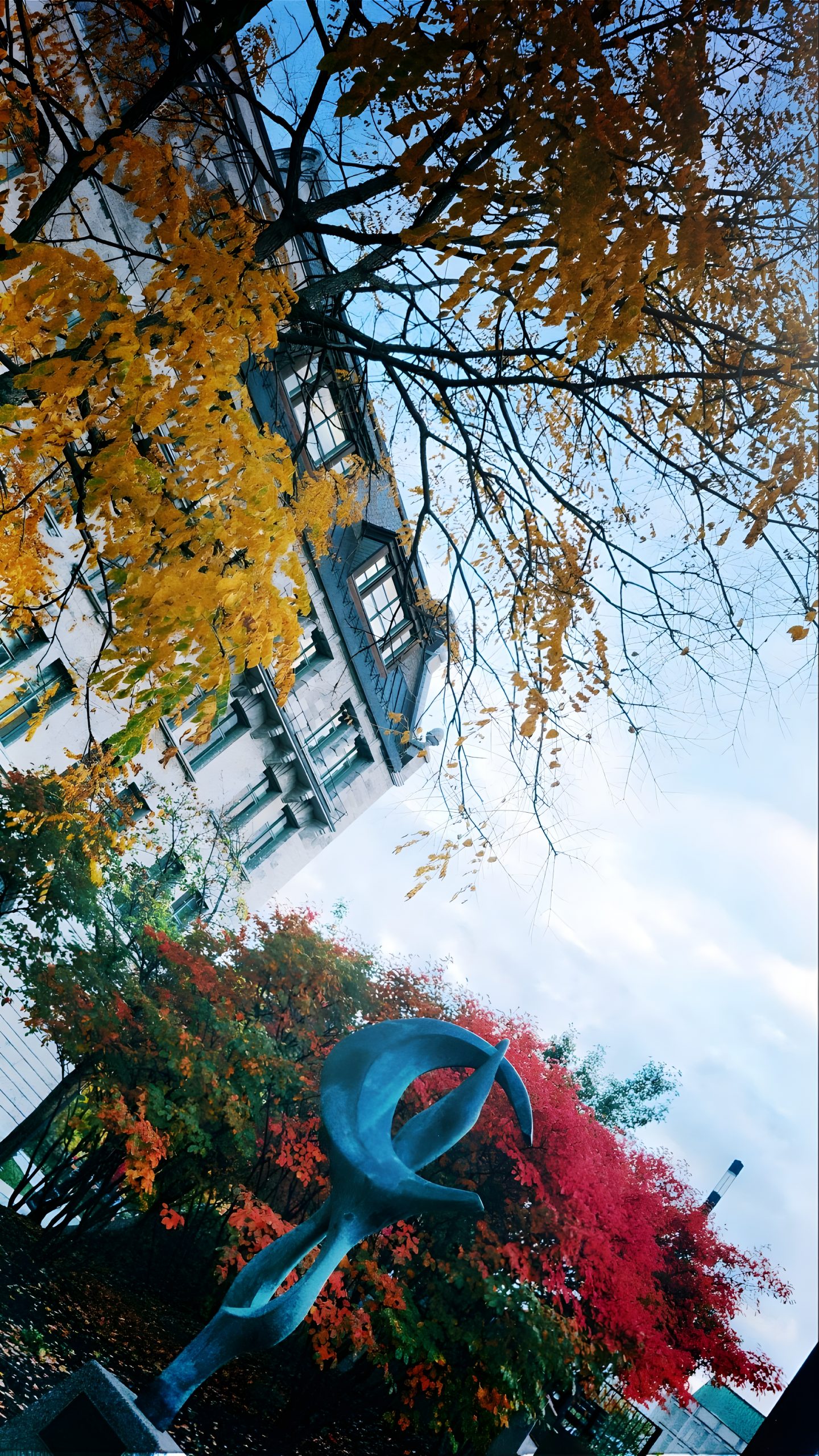
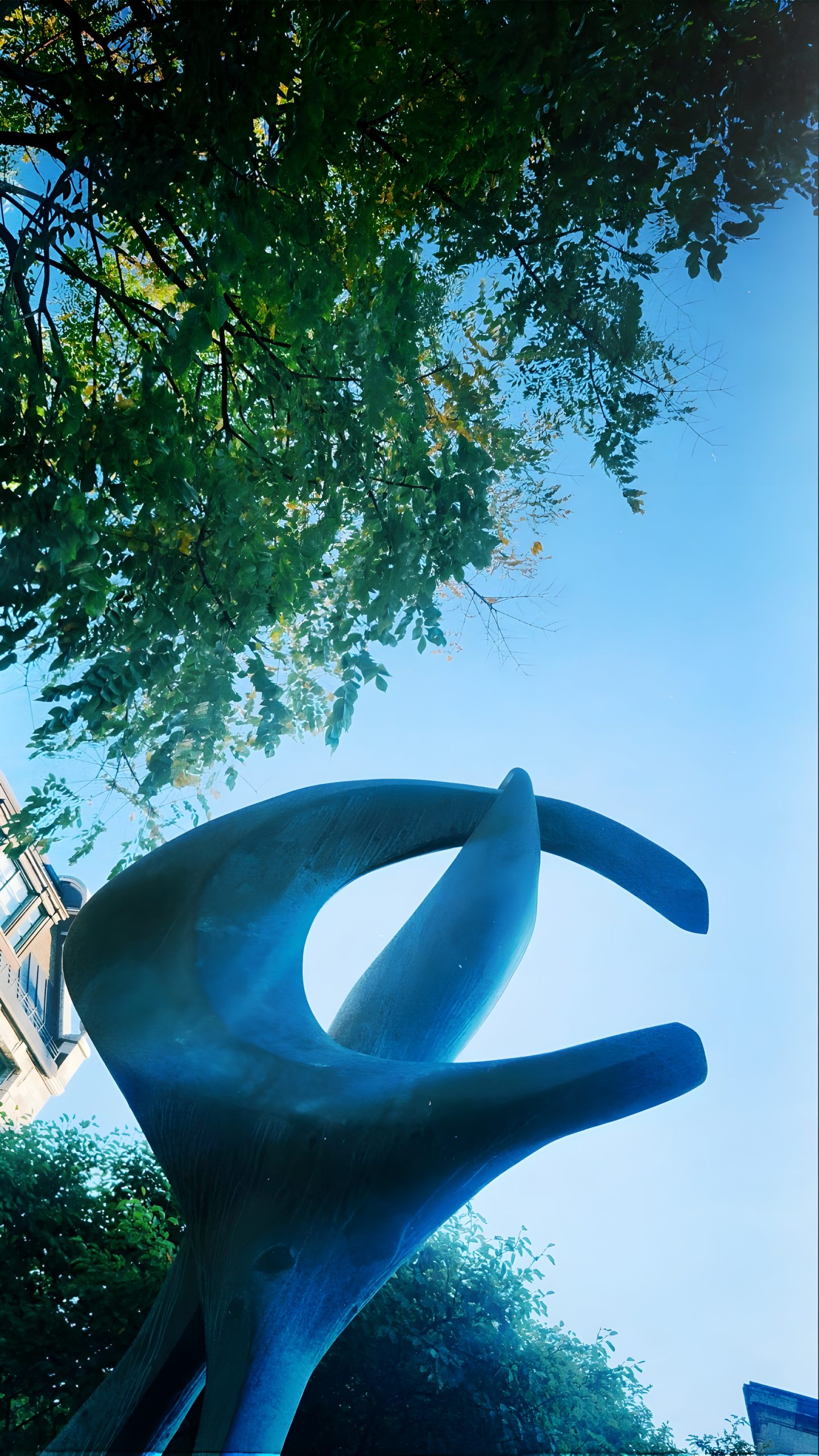
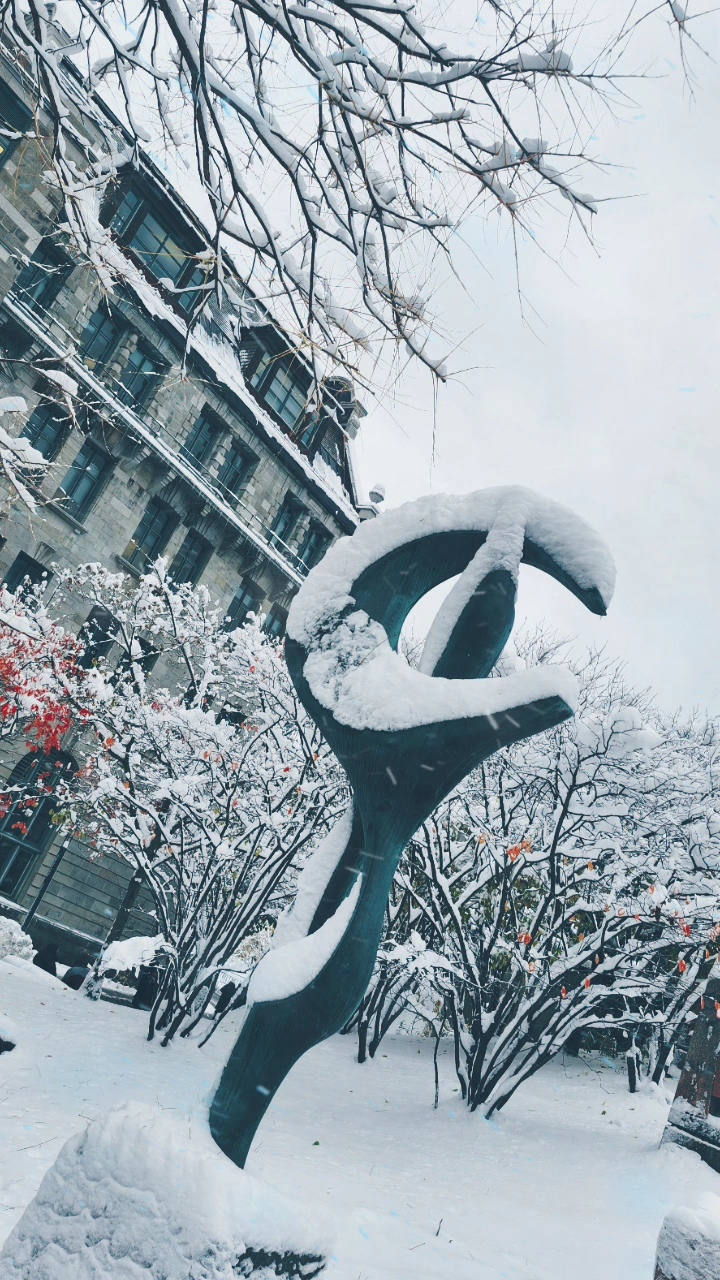
Figures 1-3: Giovanni Porretta, Exaltation, 1981, Bronze with Granite Base, Gift of Thomas O. Hecht, McGill Visual Arts Collection, 1996-021. Photographs taken and edited by Aurora Rose Desjarlais, Summer, Fall, Winter 2025.
As an abstract sculpture, it invites varied interpretations; viewers often see different meanings in the same work, shaped by their own perceptions. When I first saw this sculpture, I saw an elegant crescent moon that seemed to be in perpetual motion of being lifted into the heavens. Since it is held in place by the bronze and granite base, there is a perpetuity in the suggestion of motion, so it is eternally depicting the duality of motion and stasis that intertwine. This is a nod to the title of the artwork, Exaltation, which means “to raise in rank, power, or characters” and “to elevate by praise or in estimation.”[2] To rise in rank or power alludes to a transitory motion and action, which is in alignment with the duality of the sculpture. The sculpture seems to be visually in the process of rising, or even falling, depending on your perspective. The cycles of the moon vary, depending on the day, and its path around the Earth. There is a sense of the moon’s diversity in path in the sculpture. Even as you walk around it, it travels according to your path and direction. The moon, interconnected with Earth, follows paths that take it up or down, around, and in angles of all sorts around the planet. Sometimes you see the moon in its phase in the East, West, North or South, as it travels continually around us. The inherent static position of the sculpture and perpetual cycles of the seasons around it mirrors the relationship that we have with the moon and our daily observation of it. The inherent stasis of the sculpture also relates to the perpetuity of the moon, and how it has been connected to us for many revolutions around the sun, being observed by countless people over the centuries.
The Ionkhisotha Ahsonthennékha Karáhkwa/Nookomis Giizis/Tipiskâwi-pîsim/Moon has always been one my favorite “heavenly objects” to admire in our sky, as it is always going through a perpetual cycle of life, death, and rebirth from our point of view. Our earth is intricately interconnected and intertwined with the moon in so many ways. In another sense, the moon, from our perspective, seems to be perpetually rising high into the sky, and returning down past the horizon. This endless cycle has been the scenery in the ever-changing sky above us. To superimpose the definition of the title with the visual analysis of the sculpture: I see a crescent moon shape that is being exalted and raised higher up. The sculpture towers high, encouraging all admirers to look up into the sky to admire it in its entirety. Reflecting upon this, the moon has been a prominent figure through many cultures, traditions and communities throughout history, all around the world. Looking up at the moon is something that I am sure that we have all done at some point in our lives. The moon connects us all.
I am from a First Nations Nêhiyawak/Plains Cree community from Alberta/Saskatchewan area. I initially grew up in that area, but I am now living at Tiohtià:ke/Mooniyang/Montreal. I remember learning about the many stories from Indigenous communities across Turtle Island as I grew up. I always found the stories to be exciting, and they provoked a curiosity for knowledge within me. That curiosity for knowledge continued to this day and so I have decided to continue my study with these stories while in University from an art historical perspective, as I have the honour of working at the McGill Libraries’ Visual Arts Collection as a Curatorial Intern. I want to emphasize that my study of these stories come from the reality that I am not an elder or an expert in these stories. The intention behind my writing it so introduce others to these various Indigenous stories that I have learned from experts and elders, but to also influence others to learn by their own curiosity. I recommend seeking out stories from Indigenous knowledge keepers and elders, if you would like to learn more. Through the examination of Exaltation, I see an opportunity to learn about Indigenous teachings and stories of the moon, many of which remain central to Indigenous community knowledge and cultural practices across Turtle Island and to share with you some of the knowledge I have found, as I am not an expert.
The sculpture was created by Giovanni (John) Porretta, who received his Bachelor of Fine Arts degree from the University of Guelph, Ontario in 1975.[3] His work has been shown in numerous exhibitions all over the world, in locations like Montreal, Guelph, New York, and Italy.[4] In 2012, Porretta was elected to the Sculptors Society of Canada.[5] According to his artist statement, Porretta views sculpture as an “infinite circle,” an idea that aligns with my own interpretation of the piece.[6] The concept of an infinite circle can be connected to the cycles of the moon, which perpetually goes through the multiple phases of the moon: new moon, waxing moon, full moon, waning moon, all the way back to the new moon again. The moon is infinitely cycling through the phases. Further than that, this sculpture does not depict a new moon or a full moon but depicts a crescent moon. From that depiction, there is an intrinsic tension of motion, or perpetual slow revealing of the moon over an imaginary stretch of time. This alludes to the process of an infinite cycle, further provoking the thought of this being a crescent moon.
Throughout many Indigenous communities, traditions and cultures, especially on Turtle Island, the Ionkhisotha Ahsonthennékha Karáhkwa/Nookomis Giizis/Tipiskâwi-pîsim/Moon directs the “calendar” that the traditions follow, amass knowledge from and adhere to. The communities that look to the moon in their traditions include the Anishinaabeg, Kanienʼkéha, Haida, Nêhiyawak, and many others around Turtle Island, from the north to south, and east to west. This tells us just how connected through the Ionkhisotha Ahsonthennékha Karáhkwa/Nookomis Giizis/Tipiskâwi-pîsim/Moon we all are, as we have all witnessed it throughout time and space and bring it into our stories and histories that we tell each other.
A teaching by Grandmother Isabelle Measawige from the Anishinaabe Serpent River Nation in Ontario, is that the Creator made Mother Earth, and she was beautiful, and he loved her with all his heart.[7] Mother Earth was given instructions, governance, and the power to give birth.[8] The Creator did not want Mother Earth to be lonely, so he created another woman named Nookomis Giizis/Grandmother Moon, who hangs in the night sky.[9] The Creator told her that she has the duty and responsibility to regulate life and to maintain the order in those communities; so, the Creator gave Nookomis Giizis/Grandmother Moon governance.[10] Nookomis Giizis/Grandmother Moon was not just a celestial body, but is a sacred entity intertwined with Anishinaabe and other Indigenous cultural values and governance principles. The Moon’s teachings are also connected to 13 sacred laws that guide one through life. The 13 Grandmother Moon laws encompass concepts of reciprocity, grace, cooperation, generosity, self-awareness, communication, forgiveness, impeccability, discernment, nurturing, compassion, gratefulness, and collaboration.[11]
The Anishinaabemowin word for the moon is Nookomis Giizis/Grandmother Moon.[12] The moon was created in the beginning of time to guide the Anishinaabe, as Elder Eddie explains.[13] The Anishinaabe host ceremonies to honor Nookomis Giizis that respect humanity’s relationships and responsibilities to her.[14] Anishinaabe relationships and responsibilities are entangled in stories, teachings, songs, and ceremonies for Nookomis Giizis that start with Creation. Every Nookomis Giizis has a name for a distinct seasonal event or harvest that takes place during that moon.[15] Grandmother moon/Nookomis Giizis entails the understanding and acknowledgement that the moon is always connected to bodies of water, including the water within us.[16] Kim Anderson, Métis scholar, explained that many Indigenous cultures participate in giving thanks to Grandmother Moon through moon ceremonies.”[17]
In the Kanienkéha:ka Creation Story, adapted from a story by Ionataié:was, Kanienkéha:ka storyteller, this world was made up of just water and creatures of the water.[18] Above the world, there was a place called Karonhiá:ke/The Sky World.[19] There was a tree growing in the center of Karonhiá:ke, called the Tree of Life.[20] One day, a woman who was expecting a baby, wanted to drink tea made from the roots of the Tree of Life.[21] Her name was Atsi’tsaká:ion which means Mature Flower or Ancient Flower.[22] Her husband, Otáhe, Guardian of the Tree of Life, went to retrieve some roots for his wife, but the tree fell down, creating a hole in the ground.[23] Atsi’tsaká:ion went to look at what happened and fell through the hole and grabbed onto some seeds from the roots and around the Tree of Life.[24] A flock of birds looked up and saw her falling, so they decided to try to catch her on their backs.[25] They wanted to bring her back up to the hole, but she was too heavy for them to carry higher.[26] They lowered her down to the water below, and a giant turtle said that they could put her on his back.[27] Atsi’tsaká:ion thanked the creatures and said that she needed land to survive.[28] They attempted to retrieve some dirt, but only the muskrat was able to get some for her.[29] When it was brought to her, she was able to create the lands that now live on.[30] This is the reason why people refer to North America as Turtle Island.[31] When Atsi’tsaká:ion passed away, her head was thrown into the night sky and she became Iethihsótha Ahshonthénhkha Karáhkwa/Grandmother Moon.[32] There here is an intricate connection between the Great Turtle and the moon calendar of many Indigenous communities on Turtle Island. There is a reference to the Great Turtle of Turtle Island and Iethihsótha Ahshonthénhkha Karáhkwa/Grandmother Moon currently at the new Y-intersection, renamed Tsi Non:we Onkwatonhnhets, or “The place where our life force emerges from the earth,” created by artist Alanah Jewell and consulted by Phillip White-Cree.[33] The work of art is part of the Visual Arts Collection at McGill. This stonework is a reference to the creation story of Turtle Island by Atsi’tsaká:ion/Sky Woman and the Ohén:ton Karihwatéhkwen/Thanksgiving address.[34]
For many Indigenous communities on Turtle Island, the Lunar Calendar is specifically mapped on the back of a mihkinâhk/turtle[35]. Mihkinâhkwak/Turtles usually have 28 “scutes” or plates on the outer circle of their shell.[36] This corresponds to the number of days in a Lunar Moon Cycle. Mihkinâhkwak generally also have 13 “scutes” in the inner circle of their shell.[37] This corresponds to the number of Moons in our year, which is the time it takes the Earth to rotate around our central star, the Sun. The 13 moons all correspond to the distinct environmental events that are unique to each Indigenous community. The moon in October is called Bnaakwii Giizis/Falling Leaves Moon for the Anishinaabe, and the moon in November is called Baashkaakodin Giizis/Freezing Moon.[38] For the Nêhiyawak (Y-dialect), the tipiskâwi-pîsim for October is called the Pimihâwipîsim/Migrating Moon and for November, it is called Ihkopîwipîsim/Frost Moon.[39] [40] There are different names for the Ionkhisotha Ahsonthennékha Karáhkwa/Nookomis Giizis/Tipiskâwi-pîsim/Moon, as every area experiences different environmental events in each month and it depends on the geographical location. From the names of the different moons, one can gather knowledge. Knowing their names, one would understand that it is time to prepare for winter, or time to prepare for spring, or even time to harvest. There is an inherent connection between the names and the environmental events that occur in each geographical area that are unique to Indigenous communities. The first day of the Lunar Month corresponds to the New Moon. Throughout history, the people observed that the environmental events, water level, weather, plant cycles, animal cycles, and temperature seemed to follow the cycles of the the Ionkhisotha Ahsonthennékha Karáhkwa/Nookomis Giizis/Tipiskâwi-pîsim/Moon.[41] Melba Green, Pimachiowin Aki Guardian from the Bloodvein River First Nation, explains, “The stars are used for directions, the sun is used to tell time, and the moon is used to tell you which month you are in.”[42]
Exaltation reminds me of the Ionkhisotha Ahsonthennékha Karáhkwa/Nookomis Giizis/Tipiskâwi-pîsim/Moon and encourages me to study Indigenous teachings about her across all of Turtle Island. The eternality of the bronze statue reminds me of the constancy of the moon itself. The shape of the sculpture also reminds me of the transient nature of its shape, perpetually revealing and concealing itself as it travels around our earth. It has inspired me to research and write about it. For this post, I researched Anishinaabeg, Kanienkéha:ka, Métis, Nêhiyawak, and Rotinonshón:ni knowledge originating on Turtle Island. I introduced stories about the creation of the moon, the creation of Turtle Island, and Tsi Non:we Onkwatonhnhets. I hope that you are inspired as well after reading about Indigenous Turtle Island teachings of our Ionkhisotha Ahsonthennékha Karáhkwa/Nookomis Giizis/Tipiskâwi-pîsim/Moon as I have been.
Giving Thanks
I would love to take a moment to give my thanks to all of those that were involved with the process of writing my blog post.
Thank you to Michelle Macleod for her honored guidance with the writing and revising of my blog post.
Thank you to Dr. Madelaine Longman for her advice on perfecting the grammar and structure of my writing.
Thank you to Professor Wahéhshon Shiann Whitebean for her cherished teaching that has informed and guided my writing of this blog post that is the most respectful and honorable to Indigenous knowledge and sharing.
Without the thoughtful direction of these incredible professionals, I would not be able to give this sharing of knowledge the honor and respect that it deserves.
Finally, I also want to thank you to all of those that have taken the time to read my work after it was published. I truly appreciate your time, and I hope that my work has inspired you in some way.
Territorial Acknowledgement
I would like to begin by acknowledging that McGill University is located on unceded Indigenous lands. The Kanien’kehá:ka Nation is recognized as the custodians of the lands and waters on which we gather today. Tiohtià:ke/Montréal is historically known as a gathering place for many First Nations. Today, it is home to a diverse population of Indigenous and other peoples. We respect the continued connections with the past, present and future in our ongoing relationships with Indigenous and other peoples within the Montreal community.[43] [44]
[1] Fondazione Palazzo Strozzi (Florence, Italy), J. Paul Getty Museum, and National Gallery of Art (U.S.). Power and Pathos : Bronze Sculpture of the Hellenistic World. Edited by Jens Daehner and Kenneth D. S. Lapatin. Los Angeles: The J. Paul Getty Museum, 2015.
[2] “Exalt,” Merriam-Webster, accessed on July 30th, 2025, https://www.merriam-webster.com/dictionary/exalt.
[3] “Giovanni (John) Porretta,” Art Public Montreal, accessed on July 30th, 2025, https://artpublicmontreal.ca/en/artiste/poretta-giovanni-john/.
[4] “John Giovanni Porretta,” Sculptors Society of Canada, accessed on July 30th, 2025, https://www.sculptorssocietyofcanada.org/john-giovanni-porretta/.
[5] Ibid.
[6] Ibid.
[7] “Grandmother Moon is sacred and should be respected,” Indigenous Watchdog, accessed July 30th, 2025, https://www.indigenouswatchdog.org/update/grandmother-moon-is-sacred-and-should-be-respected/.
[8] Ibid.
[9] Ibid.
[10] Ibid.
[11] “Grandmother Moon is sacred and should be respected,” Indigenous Watchdog, accessed July 30th, 2025, https://www.indigenouswatchdog.org/update/grandmother-moon-is-sacred-and-should-be-respected/.
[12] Chiblow, Susan, “Relationships and Responsibilities between Anishinaabek and Nokomis Giizis (Grandmother Moon) Inform N’bi (Water) Governance.” AlterNative: An International Journal of Indigenous Peoples 19, no. 2 (2023): 283–92. https://doi.org/10.1177/11771801231173114
[13] Ibid.
[14] Ibid.
[15] Ibid.
[16] Ibid.
[17] Ibid.
[18] Mohawk Language Custodian Association – Kontinonhstats, Kanienkéha:ka Creation Story (Ottawa: Government of Canada, Winter 2016), 2-18.
[19] Ibid.
[20] Ibid.
[21] Ibid.
[22] Ibid.
[23] Ibid.
[24] Ibid.
[25] Ibid.
[26] Ibid.
[27] Ibid.
[28] Ibid.
[29] Ibid.
[30] Ibid.
[31] Ibid.
[32] Ibid.
[33] Cable, “McGill unveils redeveloped space.”
[34] Cable, “McGill unveils redeveloped space.”
[35] mihkinâhk means Turtle in Nêhiyawak/Plains Cree. Mihkinâhkwak is the word for two or more turtles.
[36] “Indigenous Moon,” Government of Canada, accessed July 30th, 2025, https://www.asc-csa.gc.ca/eng/youth-educators/objective-moon/indigenous-moon.asp.
[37] Ibid.
[38] Durham College, “The Thirteen Moons Teaching Cycle.”
[39] Cree Literacy Network, “Cree Language Calendar 2022.” Category: Calendar. https://creeliteracy.org/2021/09/07/calendar-2022-solomon-ratt/
[40] The Y-dialect corresponds to the Plains Cree.
[41] Cree Literacy Network, “Cree Language Calendar 2022.” Category: Calendar. https://creeliteracy.org/2021/09/07/calendar-2022-solomon-ratt/
[42] “The Lunar Calendar, Explained,” Pimachiowin Aki, accessed July 30th, 2025, https://pimaki.ca/the-lunar-calendar-explained/.
[43] This Territorial Acknowledge was written by Wahéhshon Shiann Whitebean and Dr. Karl S. Hele, with significant contributions at the final stages from Dr. Louellyn White. It has been edited for McGill University.
[44] Concordia, “Territorial Acknowledgement”
Bibliography
Cable, Eve. “McGill unveils redeveloped space” The Eastern Door, October 23, 2025. https://easterndoor.com/article/mcgill-unveils-redeveloped-space
Chiblow, Susan. “Relationships and Responsibilities between Anishinaabek and Nokomis Giizis (Grandmother Moon) Inform N’bi (Water) Governance.” AlterNative: An International Journal of Indigenous Peoples 19, no. 2 (2023): 283–92. https://doi.org/10.1177/11771801231173114.
Concordia, “Territorial Acknowledgement,” Indigenous Directions. Effective November 18th, 2025. https://www.concordia.ca/indigenous/resources/territorial-acknowledgement.html
Cree Literacy Network, “Cree Language Calendar 2022.” Category: Calendar. https://creeliteracy.org/2021/09/07/calendar-2022-solomon-ratt/
Durham College, “The Thirteen Moons Teaching Cycle.” Information and Resources. Effective November 10th, 2025. https://durhamcollege.ca/info-for/indigenous-students/information-and-resources/13-moons
“exalt,” Merriam-Webster, accessed on July 30th, 2025, https://www.merriam-webster.com/dictionary/exalt.
Fondazione Palazzo Strozzi (Florence, Italy), J. Paul Getty Museum, and National Gallery of Art (U.S.). Power and Pathos : Bronze Sculpture of the Hellenistic World. Edited by Jens Daehner and Kenneth D. S. Lapatin. Los Angeles: The J. Paul Getty Museum, 2015.
“Giovanni (John) Porretta,” Art Public Montreal, accessed on July 30th, 2025, https://artpublicmontreal.ca/en/artiste/poretta-giovanni-john/.
“Grandmother Moon is sacred and should be respected,” Indigenous Watchdog, accessed July 30th, 2025, https://www.indigenouswatchdog.org/update/grandmother-moon-is-sacred-and-should-be-respected/.
“Indigenous Moon,” Government of Canada, accessed July 30th, 2025, https://www.asc-csa.gc.ca/eng/youth-educators/objective-moon/indigenous-moon.asp.
“John Giovanni Porretta,” Sculptors Society of Canada, accessed on July 30th, 2025, https://www.sculptorssocietyofcanada.org/john-giovanni-porretta/.
Mohawk Language Custodian Association – Kontinonhstats. Kanienkéha:ka Creation Story. Ottawa: Government of Canada, Winter 2016. Accessed November 11th, 2025. https://www.kanehsatakevoices.com/wp-content/uploads/2017/04/CREATION_-as-told-by-KANIENKEHAKA-woman-storyteller-FINAL2-April-13.pdf
“The Lunar Calendar, Explained,” Pimachiowin Aki, accessed July 30th, 2025, https://pimaki.ca/the-lunar-calendar-explained/.
“Thomas Hecht,” Montreal Holocaust Museum, accessed on July 30th, 2025, https://museeholocauste.ca/en/survivors-stories/thomas-hecht/.
Yellowhorn, Eldon, and Kathy Lowinger. “Turtle Island : The Story of North America’s First People.” Toronto: Annick Press, 2017. https://www.deslibris.ca/ID/454249.
Exaltation, Ionkhisotha Ahsonthennékha Karáhkwa/Nookomis Giizis/Tipiskâwi-pîsim (la Lune) et le calendrier lunaire Mihkinâhk (la tortue)
par Aurora Rose Desjarlais (Première Nation des Nêhiyawak/Cris des Plaines, stagiaire pour la Collection d’art visuel de McGill, 2025-)
Une sculpture en particulier a toujours attiré mon attention sur le campus de McGill : Exaltation par Giovanni Porretta. Elle se trouve dans le Jardin de sculptures du Square James, entre le portail Milton, le bâtiment administratif James et le pavillon McConnell de génie. Ce carrefour animé du campus est un lieu de rassemblement important pour la communauté de McGill, et son jardin de sculptures en plein air enrichit l’expérience des œuvres qui s’y trouvent au fil des saisons. Étant étudiante en histoire de l’art, je traverse souvent ce jardin. Exaltation a été témoin de l’évolution de cette communauté au fil de nombreuses saisons, aussi ai-je choisi de la photographier tout au long de l’année (photos 1–3). Sa forme évoque Ionkhisotha Ahsonthennékha Karáhkwa/Nookomis Giizis/Tipiskâwi-pîsim (la Lune), incitant à la réflexion sur les enseignements, les récits et les pratiques culturelles autochtones qui honorent la Lune sur toute l’Île de la Tortue.
Exaltation est une sculpture en bronze sur socle de granite qui dépasse les trois mètres en hauteur. Elle présente une verticalité tridimensionnelle et n’est pas symétrique par rapport à son axe vertical, mais s’enroule autour de celui-ci en formant une courbe gracieuse et délicate. Son ondulation évoque un mouvement perpétuel, tandis qu’elle reste éternellement ancrée dans sa masse de bronze. L’artiste a employé des outils spéciaux pour rendre la surface d’Exaltation parfaitement lisse[1]. Sa patine, allant de teintes claires comme le vert émeraude à des teintes foncées comme le vert forêt, résulte de son exposition aux éléments : le vent, la pluie, le soleil et la neige en hiver. Ces conditions ont entraîné des variations à sa surface, créant ainsi des motifs colorés distinctifs. La patine verte de la sculpture en bronze évoque aussi un lien profond avec la nature, comme si la Lune elle-même avait été sculptée dans ce métal.
Photos 1-3 : Giovanni Porretta, Exaltation, 1981, bronze sur socle en granite, don de Thomas O. Hecht, Collection d’art visuel de McGill, 1996-021. Photographies prises et éditées par Aurora Rose Desjarlais, été, automne, hiver 2025.
Cette sculpture abstraite suscite des interprétations variées, chaque spectateur y découvrant des sens différents, influencés par ses propres perceptions. Lorsque j’ai vu cette sculpture pour la première fois, j’ai été frappée par l’élégance d’un croissant de lune qui semblait être dans un mouvement perpétuel d’ascension vers les cieux. Prisonnière de son socle en bronze et en granite, elle incarne pour l’éternité la tension entre le mouvement et l’immobilité. Cette interprétation est attachée au titre de l’œuvre d’art, Exaltation, qui signifie « s’élever en rang, en pouvoir ou en caractère » ou « élever par les louanges ou l’estime »[2]. Cette définition évoque une action transitoire, à l’image de la dualité représentée par cette sculpture. Visuellement, l’œuvre semble être en train de s’élever, ou de chuter, selon le point de vue. Tout comme l’astre lui-même, dont les cycles varient selon les jours et sa position autour de la Terre, la sculpture rappelle la diversité des trajectoires de la Lune. Lorsque l’on se déplace autour d’elle, l’œuvre semble également s’adapter au chemin et à la direction du spectateur. La Lune, liée à la Terre, suit des trajectoires qui la font monter ou descendre, tourner autour de la planète et adopter des angles de toutes sortes. On peut observer la Lune dans sa phase à l’est, à l’ouest, au nord ou au sud, car elle se déplace continuellement autour de nous. La position statique inhérente à la sculpture et les cycles perpétuels des saisons qui évoluent autour d’elle reflètent cette relation que nous entretenons avec la Lune et son observation quotidienne. Son immuabilité renvoie également à la pérennité de la Lune et à la manière dont elle reste liée à nous, sous les yeux d’innombrables personnes au fil des siècles et des révolutions autour du Soleil. Ionkhisotha Ahsonthennékha Karáhkwa/Nookomis Giizis/Tipiskâwi-pîsim, ou la Lune, a toujours été l’un des « objets célestes » que je préfère admirer dans notre ciel, car elle est constamment dans un cycle sans fin de vie, de mort et de renaissance. Notre Terre et son satellite sont intimement liés de multiples façons. De notre point de vue, la Lune semble perpétuellement s’élever haut dans le ciel, puis redescendre au-delà de l’horizon chaque soir. Ce cycle éternel peint le paysage céleste, toujours en mouvement, qui nous domine. Pour faire un parallèle entre la définition du titre et l’analyse visuelle de la sculpture, j’y vois un croissant de lune « exalté » qui s’élève au-dessus de nous. La sculpture se dresse bien haut, incitant tous les admirateurs à incliner la tête vers l’arrière pour l’apprécier dans son ensemble. À l’instar de cette image, nous avons assurément tous déjà levé les yeux au ciel pour observer la Lune, l’astre ayant occupé une place prépondérante dans de nombreuses cultures, traditions et communautés à travers l’histoire et le monde entier. Nous sommes tous unis sous la Lune.
Issue d’une communauté de la Première Nation des Nêhiyawak/Cris des Plaines près de l’Alberta et la Saskatchewan, j’ai grandi dans cette région, mais j’habite maintenant à Tiohtià:ke/Mooniyang/Montréal. Pendant mon enfance, j’ai découvert de nombreuses légendes des communautés autochtones à travers l’Île de la Tortue. Ces récits m’ont toujours fascinée, et ils ont suscité en moi un désir d’apprendre qui ne s’est jamais éteint et qui, d’une certaine manière, m’a poussée à approfondir leur étude sous la lentille de l’histoire de l’art à l’université. Aujourd’hui, j’ai l’honneur de travailler à la Collection d’art visuel des Bibliothèques de McGill en tant que stagiaire en conservation. Je tiens à souligner que, malgré mon intérêt intellectuel pour ces récits, je ne suis ni une aînée ni une experte en la matière. Mon intention en écrivant ces lignes est de faire découvrir aux autres ces diverses histoires autochtones que j’ai apprises auprès d’experts et d’aînés, mais aussi d’inciter les gens à satisfaire leur propre curiosité. Je recommande à celles et à ceux qui souhaitent en savoir plus de se renseigner auprès des gardiens du savoir et des aînés autochtones. Cela dit, l’examen d’Exaltation représente pour moi une occasion d’en apprendre plus sur les enseignements et les mythes des Premières Nations concernant la Lune, dont beaucoup restent au cœur des connaissances et des pratiques culturelles des communautés autochtones à travers l’Île de la Tortue, et de partager avec vous une partie de mes connaissances en tant que novice.
La sculpture a été créée par Giovanni (John) Porretta, qui a obtenu son baccalauréat en beaux-arts de l’Université de Guelph, en Ontario, en 1975[3]. Ses œuvres ont été présentées dans de nombreuses expositions à travers le monde, notamment à Montréal, à Guelph, à New York et en Italie[4]. En 2012, Porretta est devenu membre de la Société des sculpteurs du Canada[5]. Selon sa note d’intention, Porretta voit la sculpture comme un « cercle infini », une idée qui correspond à ma propre interprétation de l’œuvre[6]. Ce concept de cercle infini peut aussi s’appliquer aux cycles de la Lune, qui traverse sans cesse de multiples phases : nouvelle lune, lune croissante, pleine lune, lune décroissante, et de retour à la nouvelle lune, puis ainsi de suite à chaque cycle. Par ailleurs, la sculpture de Porretta ne représente ni une nouvelle lune ni une pleine lune, mais un croissant de lune. De cette représentation découle une tension intrinsèque de mouvement, ou une révélation lente et perpétuelle de la Lune sur une période de temps imaginaire, qui fait allusion au processus d’un cycle infini.
Dans de nombreuses communautés, traditions et cultures autochtones, en particulier sur l’Île de la Tortue, Ionkhisotha Ahsonthennékha Karáhkwa/Nookomis Giizis/Tipiskâwi-pîsim, ou la Lune, détermine le « calendrier » que suivent les traditions, dont elles tirent des connaissances et auquel elles adhèrent. Les communautés qui se tournent vers cet astre dans leurs traditions comprennent les Anichinaabés, Kanienʼkéha, Haida, Nêhiyawak, et beaucoup d’autres à travers l’Île de la Tortue, du nord au sud et d’est en ouest. Cela montre à quel point nous sommes tous connectés par Ionkhisotha Ahsonthennékha Karáhkwa/Nookomis Giizis/Tipiskâwi-pîsim, car nous avons tous observé la Lune à travers le temps et l’espace, et nous l’intégrons dans les histoires et les récits que nous nous racontons.
Un enseignement de grand-mère Isabelle Measawige, de la nation Anichinaabé de Serpent River en Ontario, raconte que le Créateur a créé la Terre Mère, qu’elle était belle et qu’il l’aimait de tout son cœur[7]. Il donna à la Terre Mère des directives, puis l’autonomie et le pouvoir de donner naissance[8]. Ne voulant pas que la Terre Mère soit seule, il créa une autre femme nommée Nookomis Giizis/Grand-mère Lune, suspendue dans le ciel nocturne[9]. Le Créateur lui révéla qu’elle avait le devoir et la responsabilité de réguler la vie et de maintenir l’ordre dans ces communautés; ainsi, le Créateur confia un rôle de gouvernance à Nookomis Giizis/Grand-mère Lune[10]. Nookomis Giizis/Grand-mère Lune n’est pas qu’un corps céleste; c’est une entité sacrée intimement liée aux valeurs culturelles et aux principes de gouvernance des Anichinaabés et d’autres peuples autochtones. Les enseignements de la Lune sont également associés à 13 lois sacrées qui guident l’individu tout au long de sa vie. Les 13 lois de Grand-mère Lune englobent les concepts de réciprocité, de grâce, de coopération, de générosité, de conscience de soi, de communication, de pardon, d’impeccabilité, de discernement, de bienveillance, de compassion, de gratitude et de collaboration[11].
Le mot pour désigner la Lune en anishinaabemowin est Nookomis Giizis/Grand-mère Lune[12]. La Lune a été créée au commencement des temps pour guider les Anichinaabés, comme l’explique l’aîné Eddie[13]. Les Anichinaabés organisent des rituels pour célébrer Nookomis Giizis, symbolisant leur engagement à préserver les liens et à assumer les obligations de l’humanité envers elle[14]. Ces relations et ces responsabilités sont tissées dans les légendes, les enseignements, les chants et les cérémonies des Anichinaabés dédiés à Nookomis Giizis, qui commencent avec la Création. Nookomis Giizis a un nom différent pour chaque évènement saisonnier ou récolte particulière qui a lieu pendant cette période[15]. La notion de Nookomis Giizis/Grand-mère Lune implique la compréhension et la reconnaissance du lien indissociable entre la Lune et l’eau, y compris dans notre corps[16]. Kim Anderson, chercheuse métisse, a expliqué que de nombreuses cultures autochtones participent à des cérémonies lunaires pour remercier Grand-mère Lune[17].
Dans le récit de la création des Kanien’kehá:ka, adapté d’un conte par Ionataié:was, conteur kanien’kehá:ka, notre monde était d’abord composé uniquement d’eau et de créatures aquatiques[18]. Au-dessus, régnait Karonhiá:ke/Le monde céleste[19]. Un arbre géant poussait au centre de Karonhiá:ke : l’Arbre de la vie[20]. Un jour, une femme enceinte voulut boire une infusion préparée avec les racines de l’Arbre de la vie[21]. Elle s’appelait Atsi’tsaká:ion, ce qui signifie Fleur mûre ou Fleur ancienne[22]. Son époux, Otáhe, gardien de l’Arbre de la vie, alla chercher des racines pour sa femme, mais l’arbre tomba, laissant un trou dans le sol[23]. Atsi’tsaká:ion alla voir ce qui s’était passé, puis elle tomba dans le trou et s’agrippa à quelques graines des racines et autour de l’Arbre de la vie[24]. La voyant tomber, une volée d’oiseaux essayèrent de la rattraper sur leur dos[25]. Ils voulaient la remonter jusqu’au trou, mais elle était trop lourde pour qu’ils puissent la porter plus haut[26]. Ils la descendirent donc jusqu’aux eaux plus bas, et une tortue géante accepta de la porter sur son dos[27]. Atsi’tsaká:ion remercia les créatures et leur dit qu’elle avait besoin de terre pour survivre[28]. Plusieurs tentèrent d’aller en chercher, mais seul le rat musqué parvint à lui en rapporter[29]. Elle créa alors les terres sur lesquelles nous habitons aujourd’hui[30]. C’est pourquoi les gens désignent l’Amérique du Nord par le nom de l’Île de la Tortue[31]. Lorsqu’Atsi’tsaká:ion mourut, sa tête fut projetée dans le ciel nocturne et elle devint Iethihsótha Ahshonthénhkha Karáhkwa/Grand-mère Lune[32]. Il existe ainsi un lien étroit entre la Grande Tortue et le calendrier lunaire de nombreuses communautés autochtones de l’Île de la Tortue. On trouve par ailleurs actuellement une référence à la Grande Tortue de l’Île de la Tortue et à Iethihsótha Ahshonthénhkha Karáhkwa/Grand-mère Lune dans la nouvelle intersection en Y sur le campus, renommée Tsi Non:we Onkwatonhnhets, ou « L’endroit où notre force vitale émerge de la terre », créée par l’artiste Alanah Jewell et installée à la suggestion de Phillip White-Cree[33]. La mosaïque, qui fait partie de la Collection d’art visuel de McGill, renvoie au récit de la création de l’Île de la Tortue par Atsi’tsaká:ion/La Femme du Ciel, et au discours de remerciement d’Ohén:ton Karihwatéhkwen[34].
Dans de nombreuses communautés autochtones de l’Île de la Tortue, le calendrier lunaire est représenté sur le dos d’une mihkinâhk/tortue[35]. Les mihkinâhkwak/tortues possèdent généralement 28 écailles ou plaques sur le pourtour de leur carapace[36], soit le nombre de jours d’un cycle lunaire, et 13 écailles dans le cercle interne[37], ce qui correspond au nombre de lunes dans une année, c’est-à-dire le temps que met la Terre pour effectuer une révolution autour du Soleil, notre étoile. Les 13 lunes sont chacune associées à un évènement naturel particulier, propre à chaque communauté autochtone. La lune d’octobre, par exemple, s’appelle Bnaakwii Giizis/Lune de la chute des feuilles pour les Anichinaabés, et la lune de novembre s’appelle Baashkaakodin Giizis/Lune du gel[38]. En nêhiyawak (dialecte en Y), la Tipiskâwi-pîsim d’octobre s’appelle Pimihâwipîsim/Lune migrante et celle de novembre, Ihkopîwipîsim/Lune de givre[39] [40]. Ionkhisotha Ahsonthennékha Karáhkwa/Nookomis Giizis/Tipiskâwi-pîsim porte ainsi plusieurs noms, puisque chaque région connaît des phénomènes environnementaux différents chaque mois, selon sa situation géographique. Ces différents noms sont aussi porteurs de connaissances. Les connaître permet de savoir qu’il est temps de se préparer pour l’hiver, pour le printemps, ou même pour les récoltes. Il existe manifestement un lien intime entre le nom de chaque lune et la période de l’année à laquelle elle correspond, lien qui est propre aux communautés autochtones où ces phénomènes cycliques se produisent dans chaque région géographique. Le premier jour du mois lunaire correspond aussi à la nouvelle lune. À travers l’histoire, les peuples ont observé que certains évènements, comme les marées, la météo, les cycles des plantes et des animaux ou la température, semblaient suivre les cycles de la Lune[41]. Melba Green, gardienne Pimachiowin Aki de la Première Nation de Bloodvein River, explique que « Les étoiles servent à s’orienter, le Soleil à indiquer l’heure et la Lune à déterminer le mois en cours »[42].
Exaltation ma rappelle Ionkhisotha Ahsonthennékha Karáhkwa/Nookomis Giizis/Tipiskâwi-pîsim/Lune et m’incite à me pencher sur les enseignements autochtones à son sujet à travers l’Île de la Tortue. Le caractère éternel de la statue de bronze évoque pour moi la persistance de la Lune dans le ciel. Sa forme me fait aussi penser à la nature éphémère des phases lunaires, alors que l’astre se révèle et se dissimule sans cesse au gré de sa trajectoire autour de notre planète. Ces réflexions m’ont donné l’envie d’écrire à ce sujet et de faire des recherches : sur les Anichinaabés, les Kanien’kehá:ka, les Métis, les Nêhiyawak et les Rotinonshón:ni, et sur leurs connaissances originaires de l’Île de la Tortue. J’espère que ces récits sur la création de la Lune, de l’Île de la Tortue et de Tsi Non:we Onkwatonhnhets auront éveillé votre intérêt pour les enseignements autochtones de l’Île de la Tortue concernant notre Ionkhisotha Ahsonthennékha Karáhkwa/Nookomis Giizis/Tipiskâwi-pîsim/Lune, tout comme ils l’ont fait pour moi.
Remerciements
J’aimerais profiter de ces quelques lignes pour remercier toutes les personnes qui m’ont soutenue dans la rédaction de mon article de blogue.
Je remercie Michelle Macleod pour ses précieux conseils lors de la rédaction et de la révision de l’article.
Je remercie la Dre Madelaine Longman pour ses suggestions qui m’ont permis de peaufiner la grammaire et la structure de mes écrits.
Je tiens aussi à remercier chaleureusement la professeure Wahéhshon Shiann Whitebean pour l’enseignement qu’elle m’a transmis et qui a éclairé et guidé la rédaction de cet article de blogue, lequel témoigne du plus haut respect et du plus grand honneur envers le savoir autochtone et son partage.
Sans l’aide précieuse de ces professionnelles exceptionnelles, je n’aurais pas pu donner à cet acte de partage de connaissances l’honneur et le respect qu’il mérite.
Enfin, je tiens également à remercier toutes les personnes qui ont pris le temps de lire mon article après sa publication. Je vous suis très reconnaissante, et j’espère que mon travail vous aura inspiré d’une manière ou d’une autre.
Reconnaissance du territoire
Nous aimerions commencer par reconnaître que l’Université McGill est située en territoire autochtone, lequel n’a jamais été cédé. Nous reconnaissons la nation Kanien’kehá:ka comme gardienne des terres et des eaux sur lesquelles nous nous réunissons aujourd’hui. Tiohtià:ke/Montréal est historiquement connue comme un lieu de rassemblement pour de nombreuses Premières Nations, et aujourd’hui, une population diversifiée d’autochtones et d’autres peuples y réside. C’est dans le respect des liens avec le passé, le présent et l’avenir que nous reconnaissons les relations continues entre les Peuples Autochtones et autres personnes de la communauté montréalaise[43] [44].
[1] Fondazione Palazzo Strozzi (Florence, Italie), J. Paul Getty Museum, et la National Gallery of Art (U.S.). Power and Pathos : Bronze Sculpture of the Hellenistic World. Édité par Jens Daehner et Kenneth D. S. Lapatin. Los Angeles: The J. Paul Getty Museum, 2015.
[2] “Exalt,” Merriam-Webster, consulté le 30 juillet 2025, https://www.merriam-webster.com/dictionary/exalt.
[3] “Giovanni (John) Porretta,” Art Public Montreal, consulté le 30 juillet 2025, https://artpublicmontreal.ca/en/artiste/poretta-giovanni-john/.
[4] “John Giovanni Porretta,” Sculptors Society of Canada, consulté le 30 juillet 2025, https://www.sculptorssocietyofcanada.org/john-giovanni-porretta/.
[5] Ibid.
[6] Ibid.
[7] “Grandmother Moon is sacred and should be respected,” Indigenous Watchdog, consulté le 30 juillet 2025, https://www.indigenouswatchdog.org/update/grandmother-moon-is-sacred-and-should-be-respected/.
[8] Ibid.
[9] Ibid.
[10] Ibid.
[11] “Grandmother Moon is sacred and should be respected,” Indigenous Watchdog, consulté le 30 juillet 2025, https://www.indigenouswatchdog.org/update/grandmother-moon-is-sacred-and-should-be-respected/.
[12] Chiblow, Susan, “Relationships and Responsibilities between Anishinaabek and Nokomis Giizis (Grandmother Moon) Inform N’bi (Water) Governance.” AlterNative: An International Journal of Indigenous Peoples 19, no. 2 (2023): 283–92. https://doi.org/10.1177/11771801231173114
[13] Ibid.
[14] Ibid.
[15] Ibid.
[16] Ibid.
[17] Ibid.
[18] Mohawk Language Custodian Association – Kontinonhstats, Kanienkéha:ka Creation Story (Ottawa: Gouvernement du Canada, hiver 2016), 2-18.
[19] Ibid.
[20] Ibid.
[21] Ibid.
[22] Ibid.
[23] Ibid.
[24] Ibid.
[25] Ibid.
[26] Ibid.
[27] Ibid.
[28] Ibid.
[29] Ibid.
[30] Ibid.
[31] Ibid.
[32] Ibid.
[33] Cable, “McGill unveils redeveloped space.”
[34] Cable, “McGill unveils redeveloped space.”
[35] mihkinâhk signifie « tortue » en nêhiyawak/cri des Plaines, et mihkinâhkwak est sa forme au pluriel.
[36] “Indigenous Moon,” Gouvernement du Canada, consulté le 30 juillet 2025, https://www.asc-csa.gc.ca/eng/youth-educators/objective-moon/indigenous-moon.asp.
[37] Ibid.
[38] Durham College, “The Thirteen Moons Teaching Cycle.”
[39] Cree Literacy Network, “Cree Language Calendar 2022.” Catégorie : Calendrier. https://creeliteracy.org/2021/09/07/calendar-2022-solomon-ratt/
[40] Le dialecte en « Y » est le dialecte cri des Plaines.
[41] Cree Literacy Network, “Cree Language Calendar 2022.” Catégorie : Calendrier. https://creeliteracy.org/2021/09/07/calendar-2022-solomon-ratt/
[42] “The Lunar Calendar, Explained,” Pimachiowin Aki, consulté le 30 juillet 2025, https://pimaki.ca/the-lunar-calendar-explained/.
[43] Cette mention de reconnaissance du territoire a été écrite par Wahéhshon Shiann Whitebean et par le Dr Karl S. Hele, avec les contributions importantes de la Dre Louellyn White lors des étapes finales. Elle a été adaptée pour l’Université McGill.
[44] Concordia, “Territorial Acknowledgement”
Bibliographie
Cable, Eve. “McGill unveils redeveloped space” The Eastern Door, 23 octobre 2025. https://easterndoor.com/article/mcgill-unveils-redeveloped-space
Chiblow, Susan. “Relationships and Responsibilities between Anishinaabek and Nokomis Giizis (Grandmother Moon) Inform N’bi (Water) Governance.” AlterNative: An International Journal of Indigenous Peoples 19, no. 2 (2023): 283–92. https://doi.org/10.1177/11771801231173114.
Concordia, “Reconnaissance territoriale”, Indigenous Directions. En vigueur le 18 novembre 2025. https://www.concordia.ca/indigenous/resources/territorial-acknowledgement.html
Cree Literacy Network, “Cree Language Calendar 2022.” Catégorie : Calendrier. https://creeliteracy.org/2021/09/07/calendar-2022-solomon-ratt/
Durham College, “The Thirteen Moons Teaching Cycle.” Information and Resources. En vigueur le 10 novembre 2025. https://durhamcollege.ca/info-for/indigenous-students/information-and-resources/13-moons
“Exalt,” Merriam-Webster, consulté le 30 juillet 2025, https://www.merriam-webster.com/dictionary/exalt.
Fondazione Palazzo Strozzi (Florence, Italie), J. Paul Getty Museum, et la National Gallery of Art (U.S.). Power and Pathos : Bronze Sculpture of the Hellenistic World. Édité par Jens Daehner et Kenneth D. S. Lapatin. Los Angeles: The J. Paul Getty Museum, 2015.
“Giovanni (John) Porretta,” Art Public Montreal, consulté le 30 juillet 2025, https://artpublicmontreal.ca/en/artiste/poretta-giovanni-john/.
“Grandmother Moon is sacred and should be respected,” Indigenous Watchdog, consulté le 30 juillet 2025, https://www.indigenouswatchdog.org/update/grandmother-moon-is-sacred-and-should-be-respected/.
“Indigenous Moon,” Gouvernement du Canada, consulté le 30 juillet 2025, https://www.asc-csa.gc.ca/eng/youth-educators/objective-moon/indigenous-moon.asp.
“John Giovanni Porretta,” Sculptors Society of Canada, consulté le 30 juillet 2025, https://www.sculptorssocietyofcanada.org/john-giovanni-porretta/.
Mohawk Language Custodian Association – Kontinonhstats, Kanienkéha:ka Creation Story. Ottawa: Gouvernement du Canada, hiver 2016. Consulté le 11 novembre 2025. https://www.kanehsatakevoices.com/wp-content/uploads/2017/04/CREATION_-as-told-by-KANIENKEHAKA-woman-storyteller-FINAL2-April-13.pdf
“The Lunar Calendar, Explained,” Pimachiowin Aki, consulté le 30 juillet 2025, https://pimaki.ca/the-lunar-calendar-explained/.
“Thomas Hecht,” Musée de l’Holocauste Montréal, consulté le 30 juillet 2025, https://museeholocauste.ca/en/survivors-stories/thomas-hecht/.
Yellowhorn, Eldon, et Kathy Lowinger. “Turtle Island : The Story of North America’s First People.” Toronto: Annick Press, 2017. https://www.deslibris.ca/ID/454249.


