


By Hiʻiakalehuakaulei Hashimoto (Kanaka ʻŌiwi), Curatorial Intern for Indigenous Art (2022-2026), McGill Visual Arts Collection
The McGill Visual Arts Collection is happy to share Spirit of the Killer Whale by Wet’suwet’en First Nation artist Tsekot Ron Austin as part of a new display, titled The Living World, located on the 5th floor of the Desautels School of Management’s Bronfman Building (1001 Sherbrooke St W).
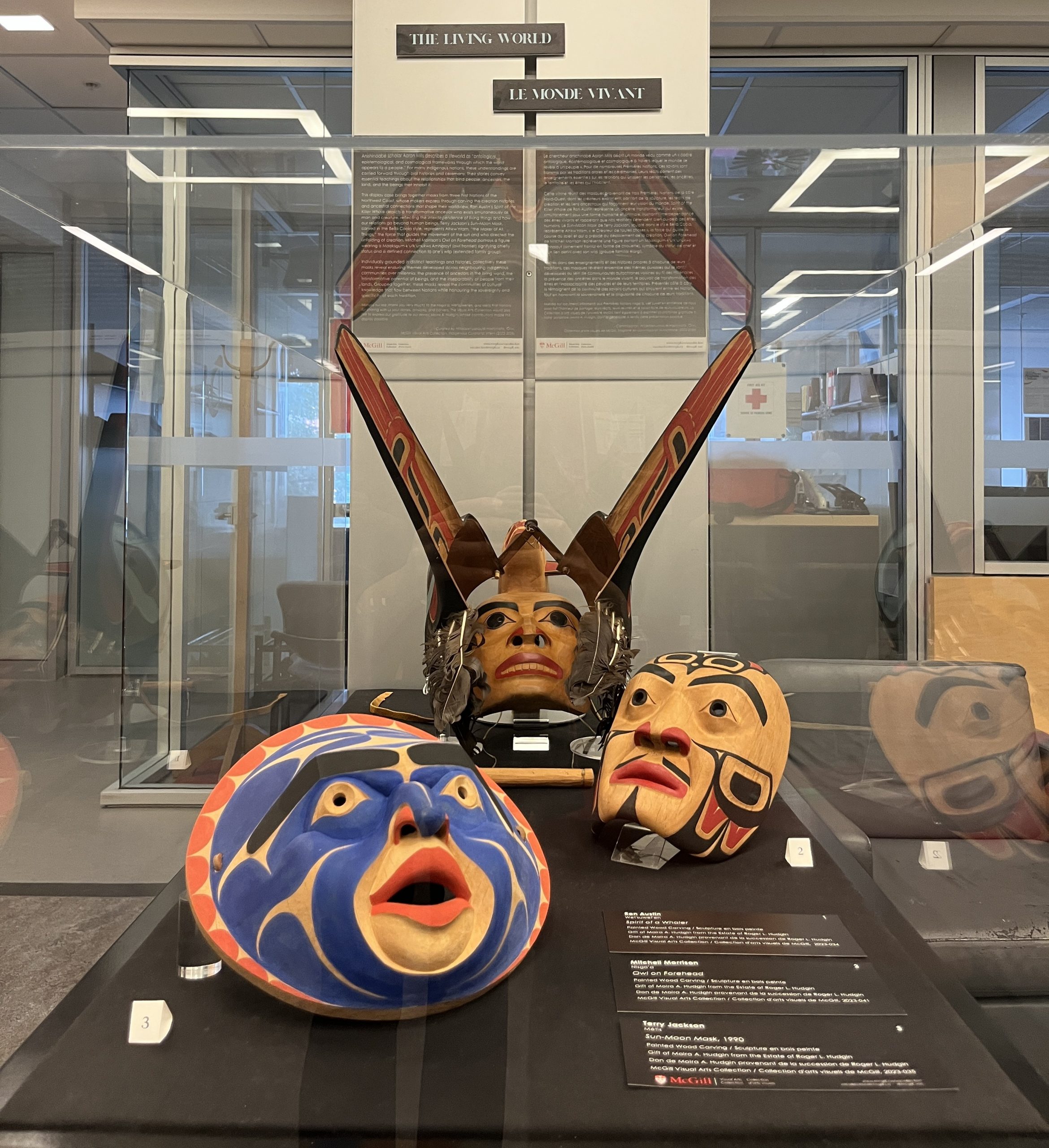
Featuring: Tsekot Ron Austin (Wet’suwet’en First Nation, 1953-)
Spirit of a Whaler
Painted Wood Carving, 52 x 23 x 56 cm
Gift of Moira A. Hudgin from the Estate of Roger L. Hudgin
McGill Visual Arts Collection, 2023-034
This transformation mask is a visually stunning and complex type of carved wooden mask, in which a larger mask opens to reveal a human face – often the face of an ancestor. Dancers don these masks during potlatches and other ceremonies, animating them with an intricate system of strings and switching between faces. This particular piece is an artistic rendition of a ceremonial transformation mask. Beginning in the late nineteenth century, increasing demand from anthropologists, museums, and collectors encouraged many Northwest Coast artists to produce carvings for sale alongside ceremonial works. In some cases, artists created versions of ceremonial objects for collectors rather than parting with pieces that remained culturally significant within their communities. Re-carving was a diplomatic solution that saw settlers’ need for aesthetic objects satisfied while ensuring the preservation of the original’s sacred authority and the continuation of carving practices. Painted in a traditional black-and-red colour scheme with cyan highlights around the eyes, Austin’s Spirit of the Killer Whale embodies centuries of cultural practices and beliefs (fig. 1).[1] Embedded within every groove and wood grain is a reflection of Indigenous systems of knowledge, history, and artistic tradition.

Killer Whale off Telegraph Cove, Vancouver Island, British Columbia, Canada, 2019, photograph,
Wikimedia Commons, Accessed July 21, 2026.
Although the transformation mask is most commonly associated with the Kwakwa̱ka̱ʼwakw People, other First Nations across the region also created them. The Canadian Museum of History possesses several such masks from a range of First Nations, including the Heiltsuk, Coast Salish, Haida, Gitksan, Tsimshian, and Nuxalk.[2] The widespread presence of this artform reflects the cultural connections and shared visual traditions that developed among the neighbouring nations in the Pacific Northwest.[3] Centuries of trade, kinship, and cultural exchange fostered shared artistic conventions, allowing certain motifs and forms to become recognizable across territories stretching from northern California to southern Alaska.[4] One such character is the killer whale, identifiable in this piece by the dorsal fin projecting from the figure’s forehead. The stories associated with the killer whale vary between nations; in some communities the face represented a person affiliated with the ‘killer whale clan of a tribe.’ [5] In others it depicts a mythical being who “created killer whales as human beings far in the distant past.”[6] Many nations also believe that killer whales embody the spirit of ancestors or deceased chiefs who live now beneath the waves in a new form (fig. 2).
Austin brings together these diverse traditions in Spirit of the Killer Whale, creating a contemporary manifestation of inter-nation artistic practices. Where traditional transformation masks linked clans to their supernatural heritage, Spirit of the Killer Whale operates as a bridge between ceremonial tradition and contemporary artistic expression, past and present. Just as a transformation mask reveals another face beneath its surface, Spirit of the Killer Whale invites viewers to look beyond its carved form. Face-to-face with the artwork, viewers encounter a living tradition in which history, identity, and storytelling continue to unfold.
N.B. To learn more about the other artworks on view in The Living World, located on the 5th floor of the Desautels School of Management’s Bronfman Building, and all other Indigenous works on public view all over campus visit the McGill Visual Arts Collection’s Virtual Tour: Indigenous Art on Public Display at McGill.
[1] Bill Holm, “Elements of the Art,” essay, in Northwest Coast Indian Art: An Analysis of Form, 50th Anniversary Edition (Seattle, Washington: University of Washington Press, 2014), 26–66.
[2] Canadian Museum of History, ed., “Transformation Mask,” Canadian Museum of History, accessed March 31, 2025, https://www.historymuseum.ca/collections/artifact/61636.
[3] William MacLeod, “Mortuary and sacrificial anthropophagy on the northwest coast of North America and its culture historical sources,” Journal de la Société des Américanistes. T. 25, n°.2, (1933): 350-51, Persée. The author’s perspectives are a product of their time.
[4] Edward Malin, A World of Faces: Masks of the Northwest Coast Indians (Portland, Oregon: Timber Press; Exclusive distributor, ISBS, 1978), 44, 53-62.
[5] Laas, “Killer Whales and Haida Culture,” Killer Whales and Haida Culture, July 14, 2023. The author indicates that in the Haida Nation, the “killer whales were a crest that was allowed to be used by certain families in either the raven or the eagles clans.”
[6] Ibid.


Leave a Reply
You must be logged in to post a comment.