



by Jessica Huang, Student Project Assistant, Rare Books & Special Collections, 2025 (BSc Pharmacology, Philosophy minor)
The more abstract, the more ideal an art is, the more it reveals to us the temper of its age. If we wish to understand a nation by means of its art, let us look at its architecture or its music.
These are the words of Oscar Wilde in “The Decay of Lying”, from notes that I came across while looking through the John Bland Canadian Architecture Collection (CAC) at the McGill University Rare Books & Special Collections as I helped curate the architectural archives exhibition Everything but the Blueprint: What Archival Documentation Reveals about the Architect as Student, Educator, and Practitioner.
Sentiments like these on the philosophy of art were what made me so drawn to the architectural archives, from the very first day. Within the CAC room’s high ceilings and arched windows, I flipped open sketchbooks to architectural ornamental details in pen, and pulled open drawers to film slides of buildings from all over the world.
Coming from science and philosophy rather than architecture, I looked at everything with fresh eyes. I had led curation and creative direction in art publications before, but this was still unusual preparation for a role in architectural archives. I found myself looking at creative work analytically, seeing where art and science met. Indeed, architecture fulfilled both aspects: the engineering precision, and the humanist questions about what people need and how beauty serves function. Every building is applied philosophy and structural engineering, at once. While I started with minimal knowledge on architecture, I understood how to look at art, see connections, and think analytically about how scientific thinking shapes creative work. Within a few weeks, I was deeply immersed in architecture, a world for which I’d previously had only passing interest.
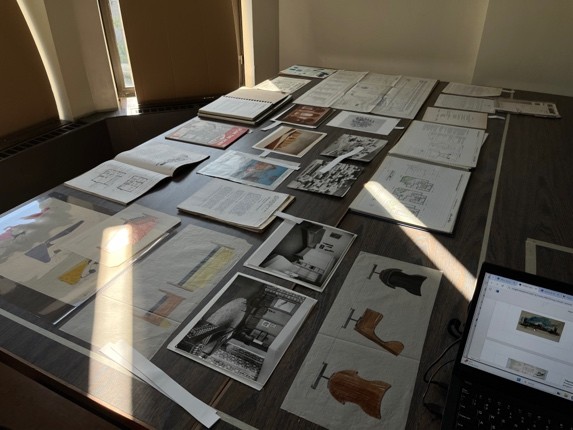
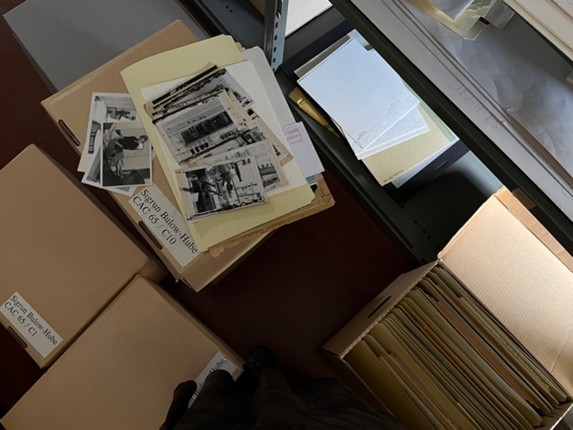
Every day I spent uncovering new, beautiful, hand drawn material in the CAC made me more entranced by the breadth and depth of both the collection, and the discipline of architecture in general.
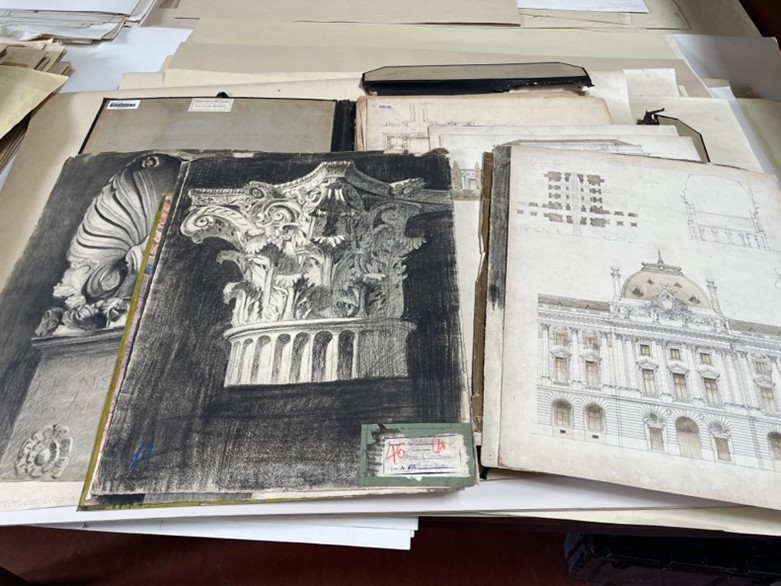
Throughout the summer, I progressed through many drawers, folders, and boxes, uncovering student sketchbooks, handwritten notes, typewritten notes, and large-scale sketches and drawings. There was one particularly stunning collection of big charcoal, graphite, and watercolour sketches of column and ornamental detail that had incredible contrast and detail. These weren’t technical blueprints, but artistic studies. It struck me that someone had spent hours rendering shadow and texture on a Corinthian capital, not because it was necessary for construction, but because understanding beauty required this kind of meticulous attention.
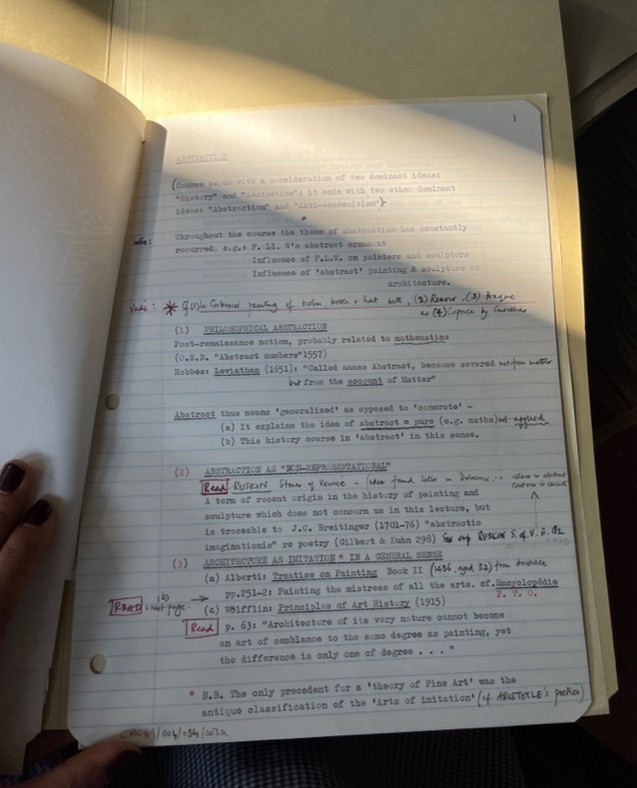
My favourite collection of text was teaching notes from Peter Collins for an architectural abstraction course, probably due to its relation to philosophy. Collins’ notes explored abstraction in architecture—the relationship between ideas and built form. It echoed the argument for architects to think abstractly before they can build concretely, and how every building begins as an idea about human needs, space, and beauty, before it becomes steel and concrete. These fundamental questions about what architecture is for felt very significant for me.
I found the tactile nature of my work particularly remarkable. In museum exhibitions, we as the public seldom get to touch the artworks. We rely primarily on sight, regarding the art and accompanying labels, keeping our distance. But looking through the architectural archival material, I was able to touch every page with my hands. This was a privilege I hadn’t preconceived would add so much to my experience of the art. Touching made it all the more tangible and palpable.
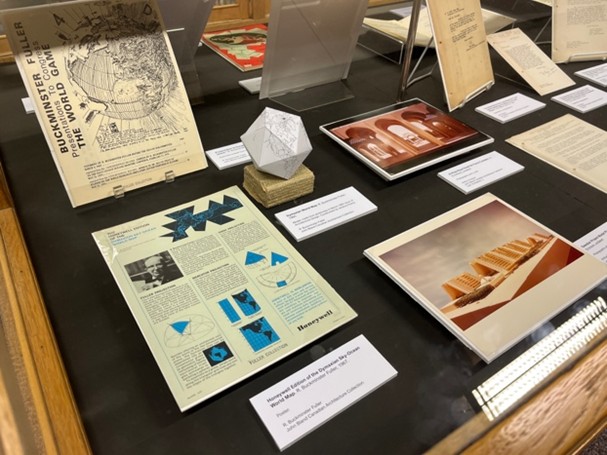
Tracing my finger over each hand drawn line and word instilled in me a sense that someone made this; someone etched every line. What became clear to me was the notion that, across time and space in human history, people have always wanted to create something beautiful. It was so personal, G.E. Wilson’s sketchbooks, Buckminster Fuller’s grand multidisciplinary ideas, Safdie’s sketches and margin notes, Bland’s notes on pedagogy as architecture school director. I was entranced.
The glass display cases of exhibitions separating the art from the viewer forms an emotional distance. This raised a curatorial question I thought about throughout: how do you convey sense of presence and closeness through the glass? How do you help viewers sense the hand that sketched the line when they can’t touch it themselves? It’s easy to overlook this, because viewers only see the art behind the glass, never experiencing it the way curators do. This was the case for me, and breaking this wall struck me in how I now perceive art and exhibitions in general.
While there was no alternative to glass display cases for our exhibition, I hoped that through the work I was doing, some of that tangibility would still translate for the viewer.
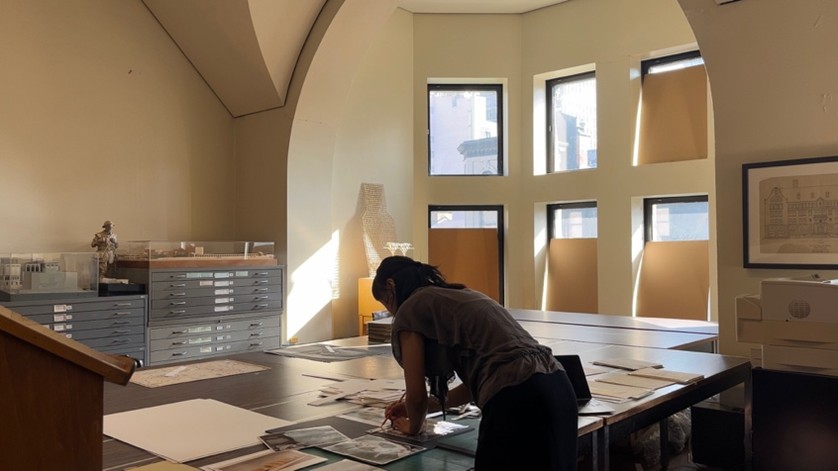
After a summer of reviewing countless folders of material, I began creating structural supports for the exhibited materials and constructing the paper geodesic dome in September. The day of installation came, and we carefully placed all the materials in the cases. It felt like months of work would finally be seen by the public.In the weeks following, I’ve brought friends to the exhibition. (I know a spot!) Sometimes, I catch visitors or wandering students leaning close to the cases, faces inches from the glass. Some point at notes, others photograph the sketches.
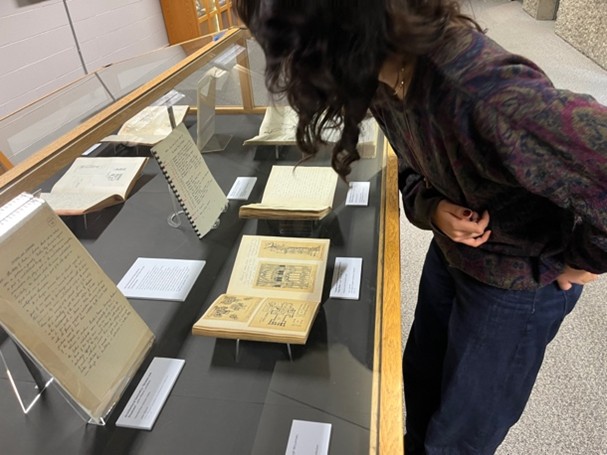
The exhibition is about the relationship between students, educators, and practitioners in architecture, and how knowledge moves between these roles. What emerged for me was also the realization that in architecture, beauty and function exist not in tension, but in co-existence.
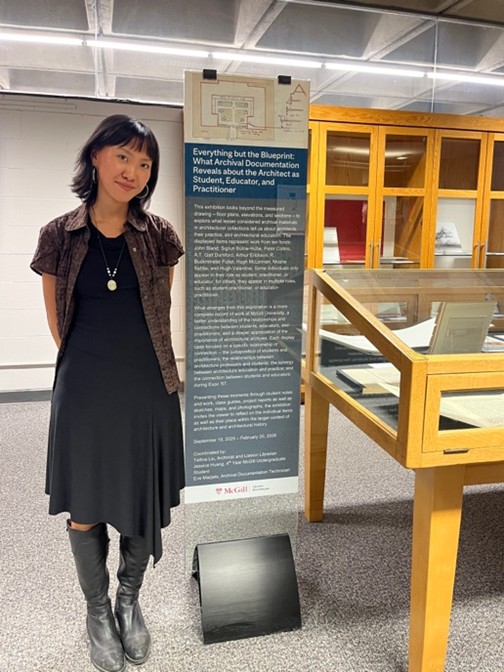
My summer spent working on this exhibition was transformative. I came into this work having grown up reading, writing, and creating art and music, then pivoting to pursue science without wanting to fully leave art behind. The architectural archives let me fulfill a part of myself that I had set aside as secondary. What these materials revealed to me is that every building, sketch, and marginal note is evidence that people have always wanted to work out how to make something both beautiful and useful.
Notes d’archives : Un été consacré à l’architecture
par Jessica Huang, assistante de projet étudiante, Livres rares et collections spéciales, 2025 (B. Sc. en pharmacologie, mineure en philosophie)
Plus un art est abstrait, plus il est idéal, plus il nous révèle le caractère de son époque. Si nous voulons comprendre une nation d’après son art, étudions son architecture ou sa musique.
Ce sont les mots d’Oscar Wilde dans « Le Déclin du mensonge », tirés de notes que j’ai trouvées en parcourant la Collection d’architecture canadienne John Bland (CAC) dans les Livres rares et collections spéciales de l’Université McGill, alors que j’aidais à organiser l’exposition d’archives architecturales Everything but the Blueprint (Tout sauf le plan) : ce que les archives révèlent sur l’architecte en tant qu’étudiant, enseignant et practicien.
Ce sont des réflexions comme celles-ci sur la philosophie de l’art qui m’ont attirée vers les archives architecturales dès le premier jour. Dans la salle de la CAC, sous ses hauts plafonds et ses fenêtres cintrées, j’ai feuilleté des carnets remplis de croquis au stylo d’ornements architecturaux, et j’ai fouillé de nombreux tiroirs remplis de diapositives de bâtiments du monde entier.
Comme mon parcours est axé sur les sciences et la philosophie, et non l’architecture, j’ai pu observer tous ces documents avec un regard neuf. J’avais déjà supervisé la sélection et la direction créative pour des publications artistiques. Malgré cela, ce travail demeurait inhabituel pour un poste dans les archives architecturales. Je me suis mise à analyser les œuvres, à chercher le point de rencontre entre l’art et la science. En effet, l’architecture répond à ces deux définitions : par sa précision technique d’abord, puis à travers les questions humanistes sur les besoins des gens et sur la façon dont la beauté sert la fonction. Chaque bâtiment est l’application simultanée de la philosophie et de l’ingénierie structurale. Même si mes connaissances en architecture étaient limitées au départ, je savais comment regarder l’art, percevoir les liens et réfléchir de manière analytique à la façon dont la pensée scientifique influence le travail créatif. En quelques semaines, je me suis retrouvée plongée corps et âme dans l’architecture, un monde pour lequel je n’avais auparavant manifesté qu’un intérêt passager.
Chaque jour passé à découvrir de nouveaux et magnifiques dessins réalisés à la main dans la CAC renforçait mon admiration pour l’étendue et la richesse de la collection, ainsi que pour l’art architectural en général.
Tout l’été, j’ai fouillé dans de nombreux tiroirs, dossiers et boîtes, y découvrant des carnets de croquis d’étudiants, des notes manuscrites, des notes dactylographiées, ainsi que des dessins et des esquisses de grande dimension. Parmi ces trésors se trouvait une impressionnante collection de grands croquis au fusain, au graphite et à l’aquarelle représentant des colonnes et des détails ornementaux d’un contraste et d’une complexité remarquables. Il ne s’agissait pas de plans techniques, mais d’études artistiques. J’ai été frappée de constater que quelqu’un avait consacré des heures à travailler les ombres et les reliefs d’un chapiteau corinthien, non pas pour des raisons fonctionnelles, mais parce que la compréhension de la beauté exigeait ce genre de minutie.
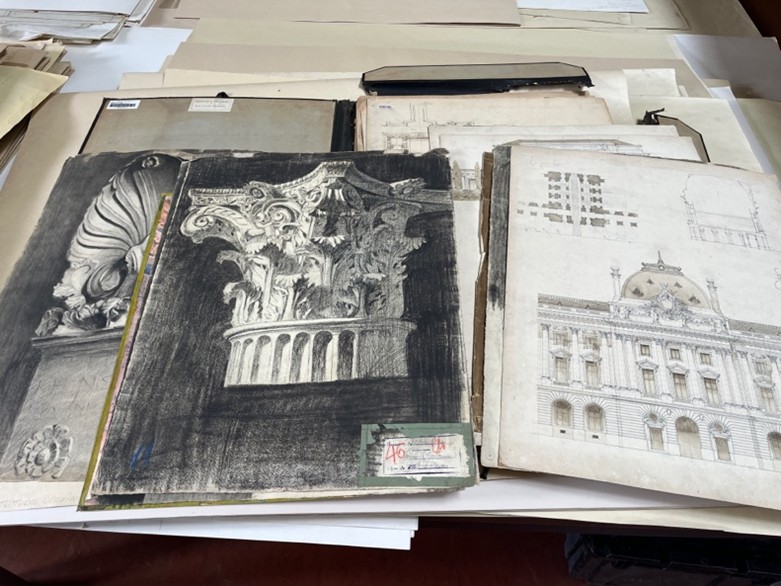
Mon recueil de textes préféré était constitué des notes de cours de Peter Collins pour un cours sur l’abstraction architecturale, probablement en raison de son lien avec la philosophie. Les notes de Collins exploraient notamment la relation entre les idées et la forme construite, reprenant l’argument selon lequel les architectes doivent penser le projet de manière abstraite avant de pouvoir le concrétiser. Tout édifice prend ainsi naissance dans l’esprit d’un architecte sous forme d’une idée qui émane de considérations relatives aux besoins humains, à l’espace et à l’esthétisme, avant de se matérialiser en acier et en béton. Ces questions fondamentales sur l’essence de l’architecture ont profondément résonné en moi.
J’ai également trouvé l’aspect tactile de mon travail particulièrement satisfaisant. Dans les expositions, nous, le public, avons rarement l’occasion de toucher les œuvres d’art : nous devons nous en remettre à la vue pour en faire l’expérience, et lire les légendes qui les accompagnent, en gardant nos distances. En consultant ces documents d’archives architecturales, j’ai eu l’occasion de manipuler chaque page. Je n’avais pas anticipé à quel point un tel privilège enrichirait mon expérience artistique. Le toucher rendait le tout d’autant plus tangible et palpable.
En suivant du bout des doigts chaque trait, chaque mot manuscrit, je pouvais sentir qu’une personne les avait créés, que quelqu’un les avait gravés dans la matière. Il m’est ainsi apparu clairement que, à travers le temps et l’espace au cours de l’histoire humaine, ce désir de créer quelque chose de beau a toujours persisté. L’exercice était véritablement personnel : les carnets de croquis de G.E. Wilson, les grandes idées multidisciplinaires de Buckminster Fuller, les esquisses et les notes marginales de Safdie, les notes de Bland sur la pédagogie en tant que directeur d’école d’architecture. J’étais fascinée.
Les vitrines des expositions, en séparant l’œuvre d’art du spectateur, créent une distance émotionnelle. Cette réflexion a soulevé une question qui m’a accompagnée tout au long de ma mission de commissaire : comment transmettre un sentiment de présence et de proximité à travers le verre? Autrement dit, comment aider les visiteurs à ressentir la main qui a tracé ces lignes lorsqu’ils ne peuvent pas y toucher eux-mêmes? Il est facile de négliger cet aspect : les visiteurs ne voient que l’œuvre derrière la vitre, sans jamais la vivre comme le font les commissaires. Ce fut aussi mon cas, et franchir ce mur a profondément influencé ma façon de percevoir l’art et les expositions en général. Même s’il n’y avait finalement pas d’autres choix que d’utiliser des vitrines en verre pour notre exposition, j’espérais que, grâce à mon travail, une partie de cette tangibilité serait tout de même perceptible pour le spectateur.
Même s’il n’y avait finalement pas d’autres choix que d’utiliser des vitrines en verre pour notre exposition, j’espérais que, grâce à mon travail, une partie de cette tangibilité serait tout de même perceptible pour le spectateur.
Après avoir passé l’été à examiner d’innombrables dossiers, j’ai commencé en septembre à créer des supports pour les documents exposés et à construire un dôme géodésique en papier. Le jour de l’installation enfin est arrivé, et nous avons soigneusement disposé tous les documents dans les présentoirs. Je sentais que le résultat de tous ces mois de travail allait enfin être dévoilé au public. Dans les semaines qui ont suivi, j’ai invité des amis à venir voir l’exposition. Je connais un endroit! Il m’arrive de surprendre des visiteurs ou des étudiants de passage penchés près des vitrines, le visage à quelques centimètres du verre. Certains désignent des notes du doigt, d’autres photographient les croquis.
L’exposition porte sur les relations entre étudiants, enseignants et professionnels de l’architecture, et sur la manière dont les connaissances circulent entre ces différents rôles. Pour moi, ce fut une prise de conscience qu’en architecture, la beauté et la fonction ne sont pas en opposition : elles coexistent.
Mon été passé à travailler sur cette exposition a été transformateur. Je suis arrivée à ce travail après avoir grandi entourée de lecture, d’écriture et de création artistique et musicale, puis avoir bifurqué vers les sciences sans vouloir pour autant laisser l’art complètement derrière moi. Les archives d’architecture m’ont permis de renouer avec une partie de moi que j’avais mise de côté, comme si elle était secondaire.
Ce que ces documents m’ont révélé, c’est que chaque bâtiment, chaque esquisse et chaque note en marge témoignent d’un désir constant : celui de comprendre comment créer quelque chose à la fois beau et utile.


Leave a Reply
You must be logged in to post a comment.