


By Hiʻiakalehuakaulei Hashimoto (Kanaka ʻŌiwi), Curatorial Intern for Indigenous Art (2023-), McGill Visual Arts Collection
“Iapetos, moreover, wedded the damsel Klymene, a fair-ankled Okeanos-daughter, and ascended into a common bed. And she bore him Atlas, a stout-hearted son, and brought forth exceeding-famous Menoitios, and artful Prometheus, full of various wiles, and Epimetheus of-erring-mind.” - Hesiod, Theogony
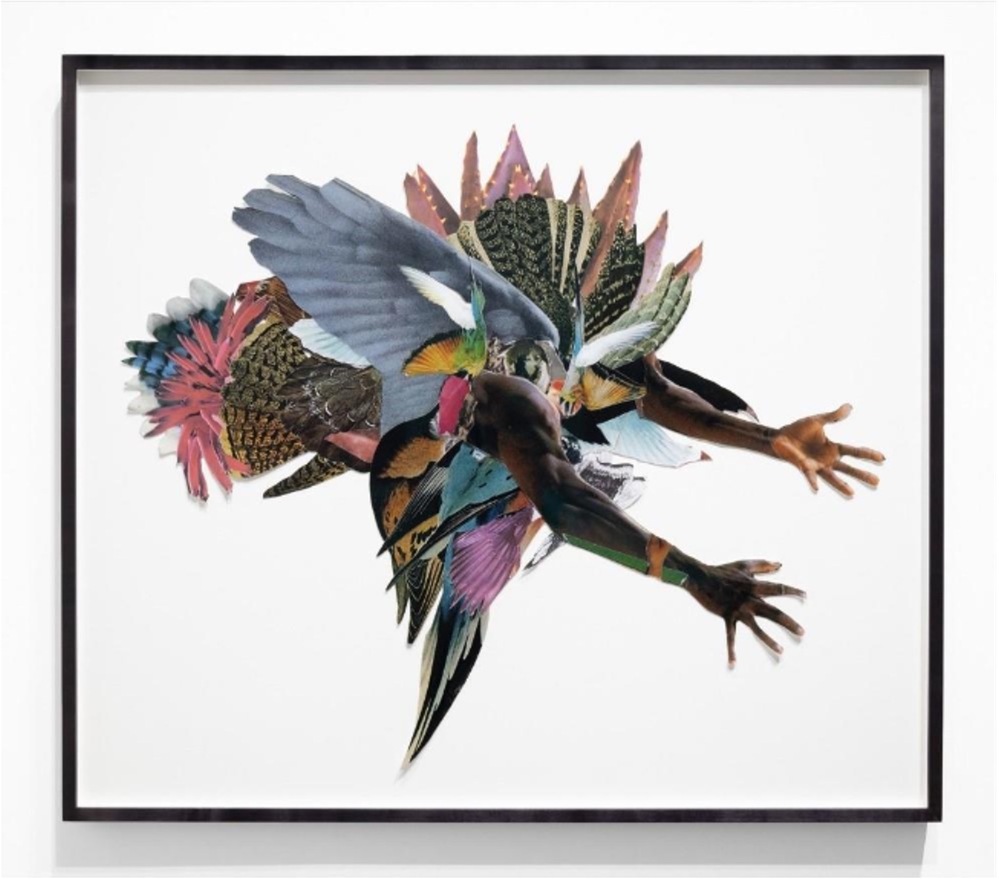
Prometheus, 2024
Magazine paper C-Print, 104.1 x 120cm
Purchased by the McGill Visual Arts Collection using funds from the Provost Office’s Anti-Black Racism Fund
McGill Visual Arts Collection 2025-013
Prometheus by Aaron Jones
Created by Aaron Jones in 2024, the artwork Prometheus was purchased by the McGill Visual Arts Collection using funds from the Provost Office’s Anti-Black Racism Fund in November of 2025. It is currently on display at the Schulich Library of Physical Sciences, Life Sciences, and Engineering on McGill University’s Downtown campus. A digital iteration of the artwork will also be featured as part of a series called “Projections: Sankofa” in the Trottier Engineering Building lobby beginning in April 2026.
The Myth of Prometheus
In Greek mythology, Prometheus is a Titan who defied the Gods of Olympus to aid humanity, most famously by stealing fire from Zeus and gifting it to mortals. This act of rebellion granted humanity knowledge, technology, and the other aspects of civilization. His punishment, being chained to a rock while an eagle devours his liver each day only for it to regenerate, casts him as a martyr figure who suffers eternally for empowering humankind. Symbolically, Prometheus has come to represent intellectual pursuits, creative passion, and the costs of progress; he embodies the tension between innovation and transgression. Prometheus is commonly portrayed in this moment of punishment, bound with chains yet unbroken, as a visual metaphor for humanity’s pursuit of knowledge. This emphasis derives in part from Aeschylus’ Prometheus Bound, which fixes the Titan within the scene of his chaining and establishes restraint and suffering as the primary conditions through which his defiance is made visible. The play is the first in a trilogy of tragedies, being the only one which survives in its entirety to this day. The latter two, Prometheus Unbound, and Prometheus Pyrphoros (Prometheus the Fire Bearer) would have likely portrayed the freeing of Prometheus by Heracles.[1]
About the Artist & Artwork
In this work, Jones offers a condensed visual panoply of the Prometheus myth, collapsing multiple moments of the narrative into a single, multifaceted figure. The outstretched hands of Prometheus reach forward in an unmistakable gesture of offering, emblematic of the Titan’s role as humanity’s benefactor. Meanwhile the mass of the composition is overtaken by avian forms that reflect the divine punishment inflicted by Zeus. By staging gift and retribution in confluence, Jones refuses a singular moral reading of Prometheus and instead invites viewers to consider him as a being defined by simultaneity—creation inseparable from consequence.
This logic is reinforced by Jones’s chosen medium: collage. His process is a Promethean act in itself, demanding foresight, selection, and synthesis, as disparate elements are consciously assembled toward a complete form already envisioned by the artist. In generating a collage, Jones effectively embodies Prometheus, labouring toward an outcome only he can fully perceive, giving creation as a gift while remaining acutely aware of its end. His process, something which he has described as an “organized, unorganized creation,” echoes both the mythic structure of forethought and his broader project of world-building.[2] Abstraction, found imagery, and resonant shapes and colours gesture beyond Western visual regimes and toward a more personal, reflective sense of being seen in the world.[3] Jones’s invocation of Prometheus situates his work within a long intellectual history that synonymizes Prometheus with Black struggles, particularly in the nineteenth century.
Historical Usage & Departure
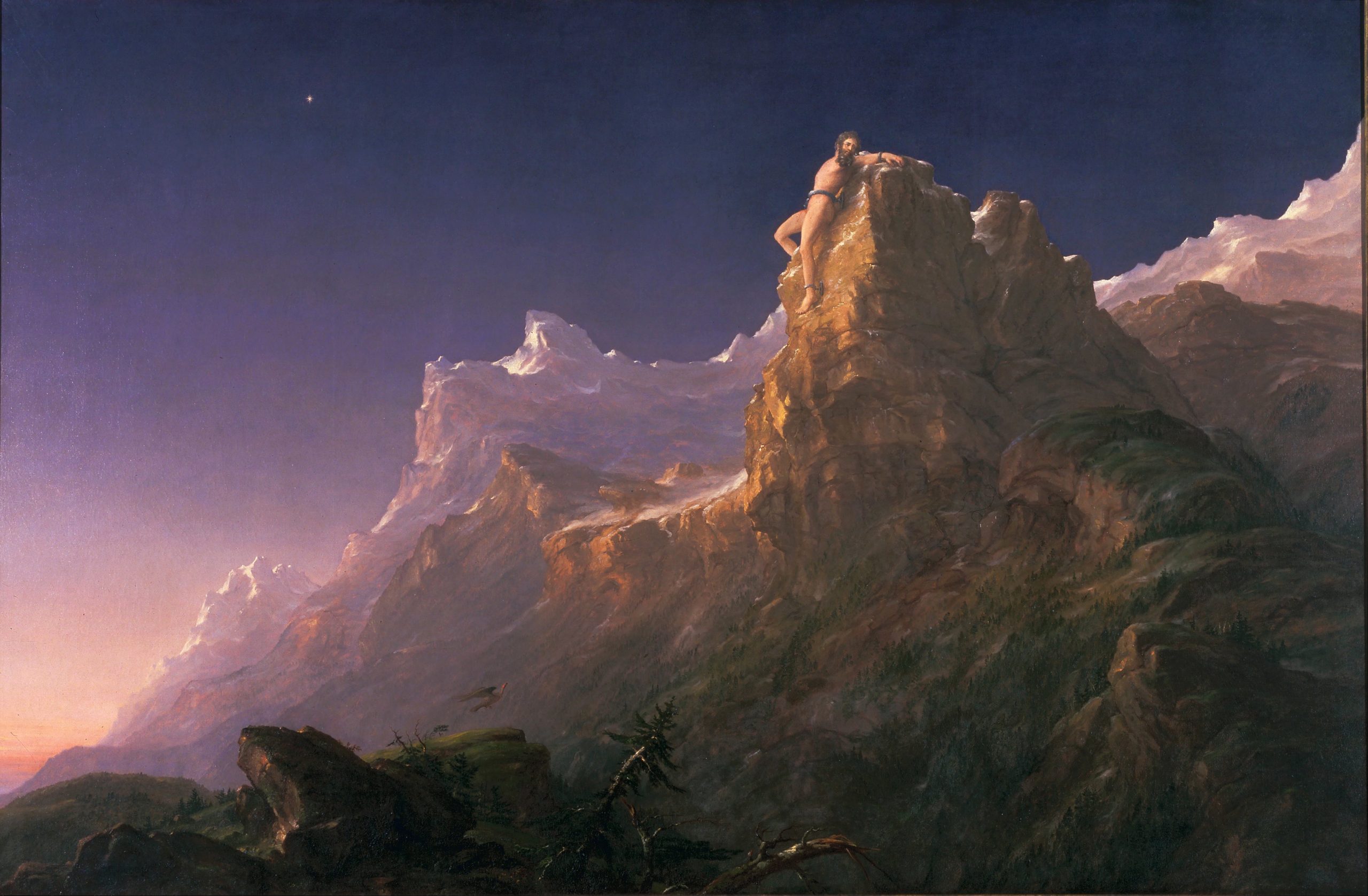
During the nineteenth century, the figure of Prometheus served as a foundational icon for the abolition movement, symbolizing an “indomitable spirit” which was used to challenge the injustices of slavery.[4] Abolitionists like James Russell Lowell framed the “chained hero” as the ultimate reformer, while Phillis Wheatley, an early Black, woman author who published a book of poetry in the eighteenth century, employed the myth as an allusion to those “starved and chained by the institution of slavery.”[5] Other prominent abolitionists such as Henry David Thoreau and Elizabeth Barrett Browning would publish their own translations of Aeschylus’s Prometheus Bound, once again conflating the plight of the enslaved with Prometheus. Thomas Cole’s 1847 painting Prometheus Bound is viewed by art historians as a visual allegory for the political and moral bondage of the era, much like the 1844 American Antislavery Almanac which featured a Promethean image of a slave mother shielding her child from an aggressive eagle.[6]
Although commonplace, such allegorical conflation is quite problematic in retrospect as it often reduced the enslaved figure to a voiceless, docile victim.[7] The Titan’s original intelligence and rebellious tendencies are stripped away to appeal to the “white sentimental imagination” without inciting fear or social upheaval.[8] Much like Aeschylus’s Prometheus, the enslaved person was seen as existing only within a state of bondage, depending on a “hero” to free them. Consequently, such portrayals frequently centred self-congratulatory white “deliverers” rather than the slave’s own capacity for self-emancipation, effectively silencing the very people the movement sought to represent.[9]
Jones’s artwork departs from this iconography of restraint and rescue by imagining Prometheus unbound. There are no chains to bind Prometheus to his punishment, nor is there a Heracles present to save him. In doing so, Jones circumvents the abolitionist paradigm of bondage altogether, rejecting the necessity of a liberating hero and reasserting Prometheus as a figure of autonomous intelligence and self-determination. This reconfiguration not only restores the Titan’s rebellious complexity but also reframes Prometheus as a vessel through which Blackness can be articulated beyond narratives of suffering. Instead, we are left to consider the other elements of Prometheus’s being; wisdom, endurance, creativity, and cunning, and how they might as Jones says, “echo some form of blackness.”[10]
[1] C. J. Herington, “Introduction to Prometheus Bound,” Arion: A Journal of Humanities and the Classics 1, no. 4 (1973): 640–67, http://www.jstor.org/stable/20163350.
[2] Sarah Sheridan, “NXT Chapter: Artists in Conversation on New Artwork at Massey,” YouTube, September 30, 2022, https://www.youtube.com/watch?v=oniNnNRt0OY.
[3] Aaron Jones, “Bio,” Aaron Jones, accessed February 25, 2026, https://www.aaronjones.ca/aaron-jones.
[4] Rupendra Guha-Majumdar, “Thoreau, Prometheus and the Universal Discourse of ‘Civil Disobedience,’” The Concord Saunterer 29 (2021): 100, https://www.jstor.org/stable/48673138., Patricia Junker, “Thomas Cole’s ‘Prometheus Bound:’ An Allegory for the 1840s,” American Art Journal 31, no. 1/2 (2000): 49, https://doi.org/10.2307/1594625.
[5] Guha-Majumdar, 120.; M.W. Hughey, Prometheus as Racial Allegory: The Sociological Poetics of W. E. B. Du Bois, Journal of African American Studies 25, 103 (2021), https://doi.org/10.1007/s12111-021-09520-y.
[6] Hughey, 103-105.
[7] Edith Hall, “The Problem with Prometheus,” Ancient Slavery and Abolition, July 1, 2011, 212-213, https://doi.org/10.1093/acprof:oso/9780199574674.003.0008.
[8] Hall, 221-222.
[9] Hall, 212, 240.
[10] Sarah Sheridan, “NXT Chapter: Artists in Conversation on New Artwork at Massey,” YouTube, September 30, 2022, https://www.youtube.com/watch?v=oniNnNRt0OY. Aaron Jones discussing the design principles that guide his artwork.


Leave a Reply
You must be logged in to post a comment.