



by Sofie Tsatas, Senior Reference Assistant & Cataloguing Editor, Marvin Duchow Music Library
Introduction
Transgender Day of Visibility (TDOV) is a day to celebrate the lives of transgender, Two-Spirit, gender nonconforming, and non-binary people while also acknowledging the systemic and disproportionate discrimination that these communities face. Founder Rachel Crandall-Crocker, a psychotherapist and the executive director of the non-profit Transgender Michigan, created TDOV in 2010 to combat the existing narrative of transness and violence in media. At that time, the only day commemorating trans people was Transgender Day of Remembrance on November 20, a day to honour transgender people who have lost their lives due to violence and discrimination. While such a day was also important and necessary, Crandall-Crocker wanted to focus on the living; to celebrate transgender people for who they are, and to spread joy and belonging within and outside the community, while also recognizing that many transgender individuals might not want to, or be able to, be open about their identity due to anti-trans violence. Of her intentions for this day, Crandall-Crocker stated in an interview with NPR: “I wanted a day that we could focus on the living. And where we could have rallies all as one community all the way around the world.”
The Impact and Importance of TDOV
Since its creation, TDOV has become a global day of recognition, and has evolved to include inclusive terminology such as Two-Spirit, gender nonconforming, and non-binary. It has sparked many events and initiatives around the world, such as festivals, block parties, and more. In 2023, the Trans Rights Readathon was created on social media asking readers to read, amplify, support and uplift the voices of trans, Two-Spirit, gender nonconforming, and non-binary authors and/or characters (click here to see McGill Libraries 2026 social media post for the Readathon).
The importance of Transgender Day of Visibility is even more pronounced when considering the anti-trans rhetoric and bills that are being introduced and passed in the United States and Canada in particular. According to the Trans Legislation Tracker, 8 anti-trans bills have passed so far in the United States in 2026 alone, with 711 bills currently in consideration across the country.
In Canada, the province of Alberta has used Bill 9’s Notwithstanding Clause to “remove Charter protection from several previously introduced pieces of legislation through which the [Albertan] Government has engaged in a full-scale attack on the ability of gender diverse people to participate in public life” (Egale Canada). Some of these pieces of legislation include the restriction of access to gender affirming care for individuals 16 and under; the banning of transgender women in sports; and requiring parental permission for youth 16 and under to change their pronouns. All this legislation has been condemned by Amnesty International, citing that they violate the Canadian Charter of Rights and Freedoms and the Canadian Human Rights Act, the latter of which states that discrimination based on gender identity and expression is prohibited.
Additionally, it’s important to note that anti-trans violence, including government legislation, disproportionately affects BIPOC individuals, those with disabilities, and individuals living below the federal poverty threshold (GLAAD).
McGill Libraries Resources
McGill Libraries offers many resources that users can use to inform themselves about trans rights and history, as well as McGill support resources. These resources have been compiled on the LGBTQ+ Studies LibGuide. Some of the resources included on the LibGuide are:

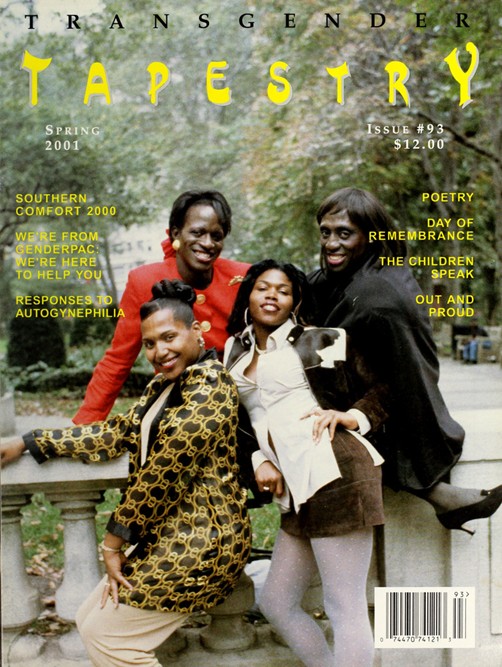
- Digital Transgender Archive: An open access and localized database to digitize trans collections from a variety of universities, libraries, archives, and more. “By digitally localizing a wide range of trans-related materials, the DTA expands access to trans history for academics and independent researchers alike in order to foster education and dialog concerning trans history” (TDA – Overview) Includes the University of Victoria Transgender Archive. Figure 1: Aiyyana Maracle was a visiting scholar at McGill University in 2006, and her fonds is available at the Transgender Archive at the University of Victoria. Figure 2: Denny, Dallas. “Transgender Tapestry Issue 93 (Spring, 2001).” Periodical. 2001. Digital Transgender Archive.

- Archives of Sexuality and Gender: Archive of historical records related to LGBTQ+ created political and social organizations from 1940 to the present. Includes manuscripts, newspapers, personal correspondence, and more. Figure 3: Excerpt from Fugues Magazine featuring an advertisement for Lesbian, Bisexual, Gay and Transgender (LBGTM) students at McGill.
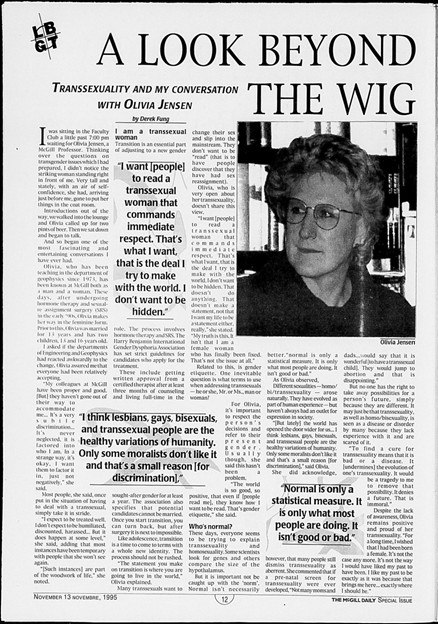
- LGBTQIA2S+ McGill Student, Faculty, and Staff Activism: Digital Exhibit: In October 2022, Dr. Alex Ketchum and Jacob Williams curated an exhibition to showcase “the work of students, faculty, and staff who advocated for increased rights, safety, and places to thrive for LGBTQIA2S+ communities at McGill. The materials highlight activism from the mid 20th century until 2022.” Figure 4: Interview with McGill Professor Oliva Jensen from the McGill Daily’s 1995 LGBT Special Issue
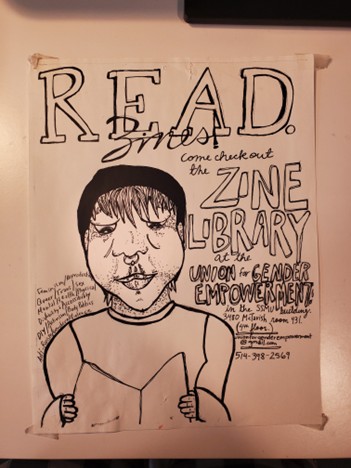
- Queer McGill: A non-profit, student run organization dedicated to creating and fostering safe spaces and communities for queer students. Figure 5: Zine issue from 2022 stored at the zine library at the Union for Gender Empowerment at SSMU.
Conclusion
Trans, gender nonconforming, nonbinary, and Two-Spirit individuals have always existed and always will. It’s important to keep advocating for and amplifying their voices, and this can be done in a multitude of ways: educating yourself on trans issues, protesting anti-trans legislation, reading and promoting books by trans authors, and attending trans-run events. This is how community is built, how joy is spread, and how trans rights remain, always, human rights.
Bibliography:
Amnesty International Canada. “Amnesty International Canada Condemns Alberta’s Use of Notwithstanding Clause to Prop Up Anti-Trans Policies.” Amnesty International, November 20, 2025. https://amnesty.ca/human-rights-news/amnesty-international- canada-condemns-albertas-use-of-notwithstanding-clause-to-prop-up-anti-trans-policies/
Egale Canada and Skipping Stone. “Alberta Relaunches Unprecedented Attack on Trans Rights – Now Using the Notwithstanding Clause.” Egale Canada, November 18, 2025. https:// egale.ca/egale-in-action/alberta-bill9-nov18/
GLAAD. “March 31st is Transgender Day of Visibility.” Accessed March 24, 2026. https:// glaad.org/tdov/
Human Rights Campaign. “International Transgender Day of Visibility.” Accessed March 24, 2026. https://www.hrc.org/campaigns/international-transgender-day-of-visibility
Ketchum, Alex, and Jacob Williams. “LGBTQIA2S+ McGill Student, Faculty, and Staff Activism: Digital Exhibit.” Airtable. Acessed March 24, 2026. https://airtable.com/ apptSAju1uUEdBdq3/shrQuc0db9IBIWKhX/tbl9ZpbTTUbXwBZbp
Kim, Juliana, and Jonathan Franklin. “Trans Day of Visibility began 15 years ago. The founder is still moved by its success.” NPR, March 30, 2024. https:// www.npr.org/2024/03/30/1241589753/transgender-day-of-visibility-rachel-crandall- crocker
Miller, Michael David. “LGBTQ+ Studies LibGuide – Guide Overview.” McGill Libraries. Accessed March 24, 2026. https://libraryguides.mcgill.ca/LGBTQ/overview
Trans Legislation Tracker. “2026 Anti-Trans Bills Tracker.” Accessed March 24, 2026. https:// translegislation.com/
“Trans Rights Readathon.” Accessed March 24, 2026. https://transrightsreadathon.carrd.co/
Wereley, Stephanie. “Honouring Queer and Trans Trailblazers.” McGill Reporter, October 6, 2025. https://reporter.mcgill.ca/honouring-queer-and-trans-trailblazers/
Wikimedia Foundation. “Transgender Rights in Canada – Discrimination Protections.” Last modified March 23, 2026. https://en.wikipedia.org/wiki/ Transgender_rights_in_Canada#Discrimination_protections


Leave a Reply
You must be logged in to post a comment.