


by Jenn Riley, Associate Dean, Strategic Initiatives and Andrea Miller-Nesbitt, Liaison Librarian at Schulich Library of Physical Sciences, Life Sciences, and Engineering
December 3 is the annual International Day of Persons with Disabilities, as proclaimed in 1992 by the United Nations. According to the World Health Organization, “The day is about promoting the rights and well-being of persons with disabilities at every level of society and development, and to raise awareness of the situation of persons with disabilities in all aspects of political, social, economic, and cultural life.”
The Accessible Canada Act defines a disability as “any impairment, including a physical, mental, intellectual, cognitive, learning, communication or sensory impairment – or a functional limitation – whether permanent, temporary or episodic in nature, or evident or not, that, in interaction with a barrier, hinders a person’s full and equal participation in society. Internationally, about 15% of the world’s population live with a disability, and 80% of those live in developing countries. A 2022 survey showed that 27% of Canadian adults have one or more disability that impacts their lives.
On the International Day of Persons with Disabilities, McGill and the Libraries confirm our commitment to equity for people with disabilities, providing accommodations when universal design is not possible, and inclusion of persons with disabilities in all of campus life.
Campus Events
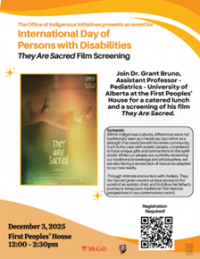
McGill is celebrating the important day with several events. On December 2, as a leadup to the celebration, the Equity Team and Digital Communications are sponsoring a conversation with digital accessibility expert Lucy Greco, describing her experience on her recent visit to McGill, and reflecting on her decades of accessibility advocacy.
On December 3, the McGill Office of Indigenous Initiatives is sponsoring a screening of the film, They Are Sacred, which follows an autistic child and his father’s work to reclaim traditional knowledge about the condition and how autistic people should be celebrated.

In the evening, the McGill Equity Team is sponsoring a Keynote Speaker – Grant Bruno, Assistant Professor of Pediatrics at the University of Alberta and a member of the Samson Cree Nation, will present Decolonizing Understandings of Neurodiversity: Indigenous Knowledge Systems and the Restoration of Belonging, also focused on providing traditional perspectives to support autistic children.
Disability Resources
The McGill Libraries hold a range of resources on disability from a variety of perspectives – from and for researchers, parents and caregivers, artists, and activists, allies, and persons with disabilities themselves.
Virtual book display
You can view a curated collection of books by and for people with disabilities and their allies. Topics include the history of the disability justice movement, intersections of disability and other identities such as race and sexuality, disability and capitalism, ableism in academia, and so much more. Each work explores visible and/or invisible disabilities through the lens of pride, empowerment, and identity.
Some highlights include:
- Memoires by disability rights activists such as Alice Wong’s Year of the Tiger : An Activist’s Life, and Rebekah Taussig’s Sitting pretty : the view from my ordinary resilient disabled body
- Books about intersectionality such as Kala Allen Omeiza’s Autistic & black : our experiences of growth, progress, and empowerment, Eli Clare et al Exile and pride : disability, queerness, and liberation, and John T Ward’s Indigenous disability studies
- Books for kids and youth including Sharon Draper’s Out of my mind, Judith Heumann’s Rolling warrior : the incredible, sometimes awkward, true story of a rebel girl on wheels who helped spark a revolutionand Shane Burcaw’s Not so different : what you really want to ask about having a disability.
- Works related to disability justice including Liat Ben-Moshe’s Decarcerating disability : deinstitutionalization and prison abolition, Sins Invalid’s Skin, tooth, and bone : the basis of movement is our people : a disability justice primer, AJ Wither’s Disability politics and theory, and Marta Russell’s Capitalism & disability : selected writings by Marta Russell.
- Books about academia and disability including Jay Dolmage’s Academic Ableism : Disability and Higher Education, Christopher McMaster’s Disability and the university : a disabled students’ manifesto, and Nicole Brown’s Lived experiences of ableism in academia : strategies for inclusion in higher education
We hope these works will expand our understandings of ‘access’, challenge systemic ableism, and inspire change and action. Let us celebrate all the diversity that disability brings to the human experience and “aim to help build a world where accessibility is understood as an act of love instead of a burden or an afterthought.” (Access is Love)
Rare & special items from the Osler Library of the History of Medicine
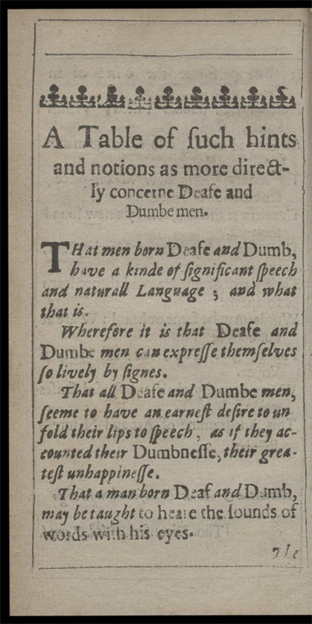
In our rare and special collections, we also hold many resources on disability. At the Osler Library of the History of Medicine in particular, you can view resources as far back as 800 BC (!!!) all the way to modern times. For example, a 1648 treatise by John Bulwer (1606-1656) entitled Philocophus describes for the first time in Britain lip-reading as a method of communicating with and teaching the Deaf.
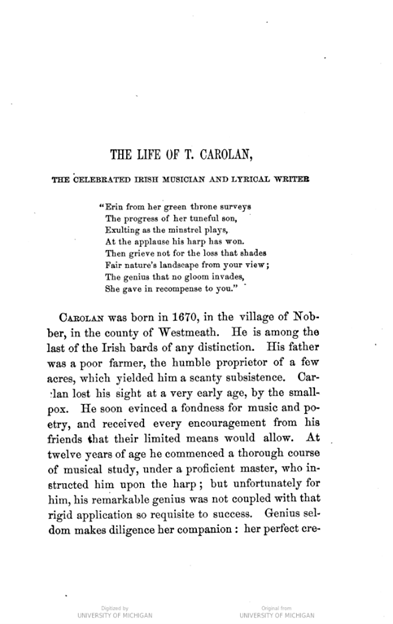
From a bit later, 1816, comes a book printed in Edinburgh, chronicling DeafBlind person James Mitchell’s efforts to learn language by feeling letters cut in relief and associating them with words by then touching the actual objects. Beauties and Achievements of the Blind, from 1854, is an account of the accomplishments of many people who are blind and is an early example of exploring the prejudice that comes with disability.
Finally, an example of a more modern work, from the British Columbia Coalition of People with Disabilities, AIDS & Disability Action Program comes a pamphlet in braille, Know about HIV and AIDS, reminding us of the challenges faced by people with multiple disabilities. These titles and many others are available by visiting the Osler Library.


Leave a Reply
You must be logged in to post a comment.